
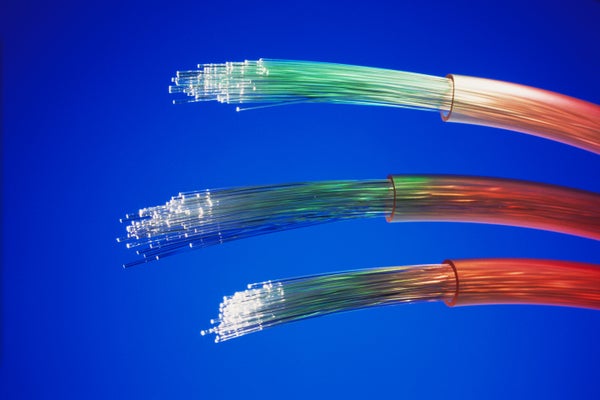
A new type of hollow optical fibre promises to boost the amount of data that can be carried in each glass strand, and to do so over longer distances. This could help to make telecommunications systems faster and more efficient.
The design, described in Nature Photonics on 1 September1, replaces the hair-thin wire of solid glass that typical fibres are made from with a system of glass ‘straws’, in which five small cylinders, each containing two nested cylinders, are attached to the inside rim of one main cylinder. The diameter of each tube is finely tuned in such a way that that the space can only accommodate light of certain wavelengths. This means that when a light pulse of an appropriate wavelength is sent down the hollow central gap, it will stay there, rather than escaping.
“We really think this could be transformative,” says co-author Francesco Poletti, a photonics and materials-science researcher at the University of Southampton, UK.
On supporting science journalism
If you're enjoying this article, consider supporting our award-winning journalism by subscribing. By purchasing a subscription you are helping to ensure the future of impactful stories about the discoveries and ideas shaping our world today.
“If the new fiber can be manufactured and installed easily and proves to be durable, the result might be a faster, better classical Internet,” says Rod Van Meter, a quantum network engineer at Keio University in Tokyo.
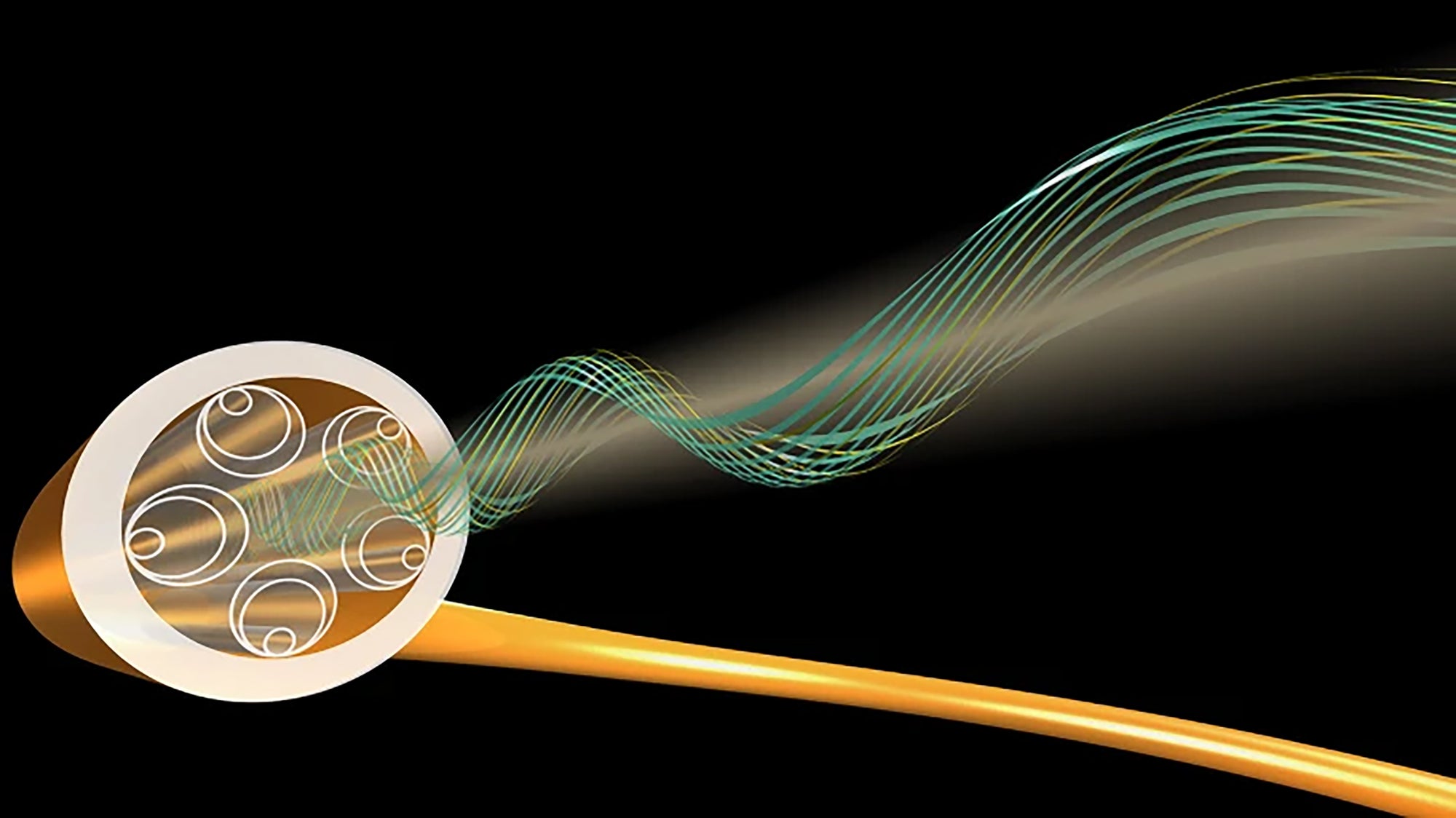
Fibres that contain hollow glass tubes nested inside one another can prevent light from escaping.
Prof Francesco Poletti and Dr Greg Jasion, University of Southampton
The fibres will be produced by a start-up company called Lumenisity, a spin-off from Southampton that was bought by Microsoft in 2022. A typical glass fibre is made by melting a piece of glass, then stretching it to produce a strand of the desired thickness. To manufacture their hollow fibres, the researchers start with a larger version of their design — measuring about 20 centimetres in diameter. The hollows are pressurized during stretching, so that the configuration stays the same as the whole structure becomes around 100 micrometres wide.
Making connections
Hollow optical fibres of various designs already exist and have found niche applications, for example, in connecting the many computing units in data centres, where speed is of the essence (light travels 45% faster through hollow, air-filled tubes than through solid glass). Van Meter calls the increase in speed “a dramatic change that people will pay a lot of money for.”
Poletti says he has been perfecting the design for more than ten years, and that it is the first one that could actually replace fibres in mainstream applications. The optical fibres that carry most of the world’s Internet traffic have improved little over the past four decades. They lose half of the light they transmit every 15 kilometres or so — 20 km for the most advanced versions — mainly because it is absorbed by the glass. Poletti and his colleagues’ design loses half of the light every 33 km. This means that the stations used to boost and re-transmit signals could be located farther apart from each other than they are at present. “If new technology comes along and says you can skip one building every two or three, that’s a very significant cost saving,” Poletti says.
In addition to cutting losses, the hollow fibres can carry more than 1,000 times more power, and can do so over a broad spectrum of wavelengths — including the single-photon pulses of visible-spectrum light that are typically used for quantum-communication systems. Common fibres are typically only efficient at the infrared ‘telecom wavelengths’ of around 1.5 micrometres.
"This result is very interesting for the quantum communication community," says Tracy Northup, an experimental physicist at the University of Innsbruck in Austria. Until now, hollow fibres have been prohibitively expensive even for small-scale laboratory experiments, she adds. "We in the research community can hope that scaled-up production may bring prices down significantly in the future."
This article is reproduced with permission and was first published on September 2, 2025.