New Issue: Orbital Catastrophe Ahead? Read Now

Fields Medals Are Concentrated in Mathematical ‘Families’

Elite mathematicians tend to pass their prestige down to advisees

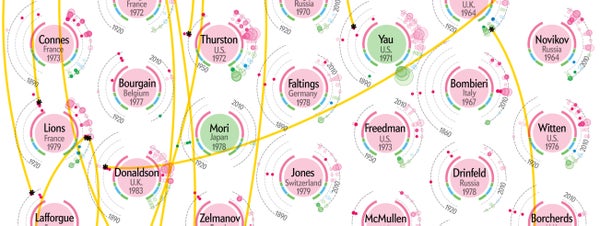
Detail of chart that plots advisor and advisee connections between Fields Medalists.

Shirley Wu; Source: “Elitism in Mathematics and Inequality,” by Ho-Chun Herbert Chang and Feng Fu, in Humanities and Social Sciences Communications; January 2021 (data)


On supporting science journalism

If you're enjoying this article, consider supporting our award-winning journalism by subscribing. By purchasing a subscription you are helping to ensure the future of impactful stories about the discoveries and ideas shaping our world today.


In mathematics, as in many fields, who you know matters. An analysis of mathematicians' “ancestors” (their graduate school advisers) as well as their descendants (the students they advised) shows that elite researchers tend to produce elites. Mathematicians Feng Fu of Dartmouth College and Ho-Chun Herbert Chang of the University of Southern California analyzed connections among 240,000 mathematicians and found that winners of math's highest honor, the Fields Medal, were concentrated among just a few mathematical families. “If you want to win a Fields Medal, you want to study with a Fields Medalist,” Fu says.

Fu and Chang also tracked mathematicians' ethnicities* and found that “elite” researchers—defined as Fields Medalists and those closely connected to them—are usually American or European, despite the fact that mathematicians around the globe have made significant discoveries. Moreover, elites tend to have advisers and advisees that are also more American and European than the general population of mathematicians. “This is urging elite institutions to think carefully about how they can help elevate underrepresented mathematicians,” Chang says.
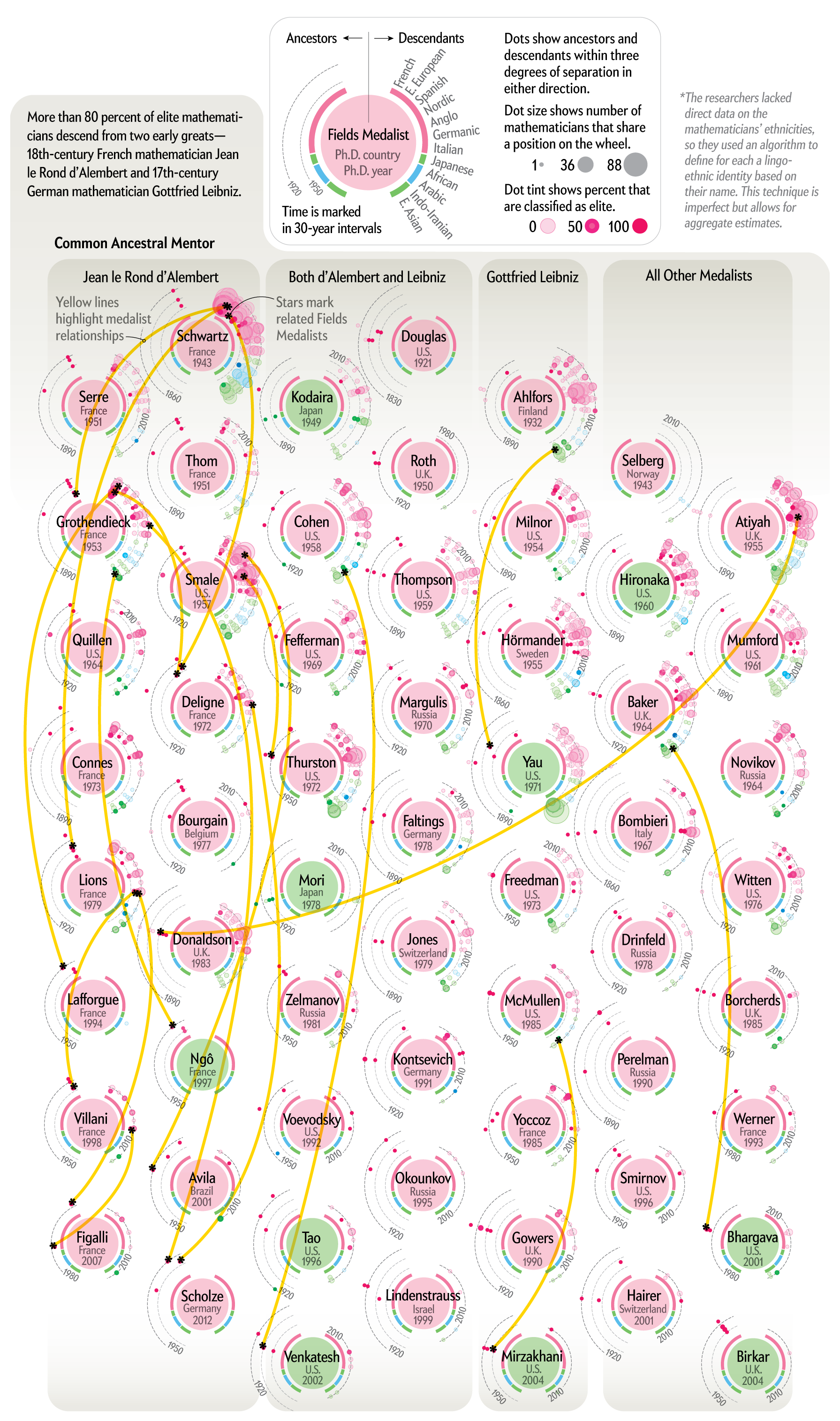
Chart plots advisor and advisee connections between Fields Medalists, with nodes color-coded by lingo-ethnic identity.

Credit: Shirley Wu; Source: “Elitism in Mathematics and Inequality,” by Ho-Chun Herbert Chang and Feng Fu, in Humanities and Social Sciences Communications; January 2021 (data)

Clara Moskowitz is chief of reporters at Scientific American, where she covers astronomy, space, physics and mathematics. She has been at Scientific American for more than a decade; previously she worked at Space.com. Moskowitz has reported live from rocket launches, space shuttle liftoffs and landings, suborbital spaceflight training, mountaintop observatories, and more. She has a bachelor’s degree in astronomy and physics from Wesleyan University and a graduate degree in science communication from the University of California, Santa Cruz.

More by Clara Moskowitz

Shirley Wu is an award-winning creative focused on data-driven art and visualizations. She combines her love of art, math and code into colorful, compelling narratives that push the boundaries of the Web. Her work can be found at https://shirleywu.studio.

More by Shirley Wu
Scientific American Magazine Vol 325 Issue 1This article was published with the title “Mathematical Privilege” in Scientific American Magazine Vol. 325 No. 1 (), p. 80
doi:10.1038/scientificamerican0721-80

Subscribe to Support Independent Journalism

Great science journalism requires human expertise, time, effort and creativity. And it costs money. That’s why I and the journalists here at Scientific American hope you’ll join our community.

When you subscribe, you are supporting staff and freelance journalists who are passionate about telling science stories that are true, important and compelling. Our editors and reporters are often experts in their fields, which means they understand the nuances of big discoveries and can untangle the breakthroughs from the hype. With a subscription, you are also supporting rigorous fact-checking to ensure the words we publish are precise and accurate. And you’re supporting original illustrations, graphics and photos that bring you closer to an advanced laboratory, an ice sheet in Antarctica or a space mission in orbit. You’re helping us craft other types of high-quality journalism as well: Our newsletters are carefully written, edited and curated by staffers you have or will come to know and love. Our Science Quickly podcast is based on original reporting, collaboration with editors and scientists and exacting production.

Subscriptions keep this engine running so we can continue to deliver thoughtful, rigorous and independent science journalism to you. In an era of viral misinformation, this work is crucial. If you value what we do, I hope you’ll consider joining us as a subscriber

Thank you,

Jeanna Bryner, Editor in Chief, Scientific American

Subscribe