
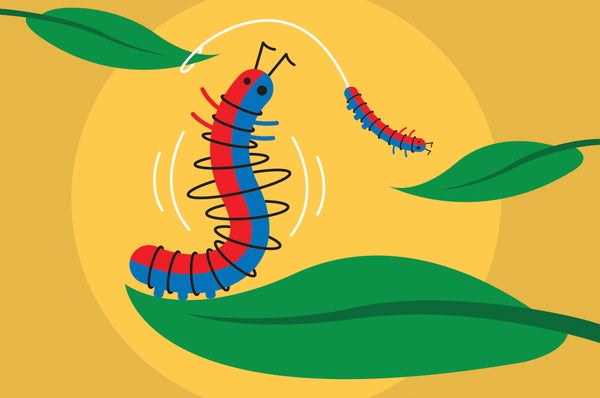
When facing an intruder, animals generally tend to fight, flee or simply freeze. But certain baby caterpillars do something else entirely: they vibrate.
Newly hatched warty birch caterpillars, each smaller than a single sesame seed, live and feed alone on the very tips of leaves. In a recent study in the Journal of Experimental Biology, scientists found that the caterpillars are fiercely protective of their little abode. If another caterpillar wanders into their territory, these tiny critters start furiously drumming their heads, shaking their bodies and scraping their butts against the leaf—a series of complex vibratory behaviors to signal that their leaf tip is off-limits.
This research “takes me into how complex the sensory world of even a tiny, tiny organism is that humans are just not aware of,” says Jayne E. Yack, a neuroethologist at Carleton University and senior author of the new study.
On supporting science journalism
If you're enjoying this article, consider supporting our award-winning journalism by subscribing. By purchasing a subscription you are helping to ensure the future of impactful stories about the discoveries and ideas shaping our world today.
The tiny caterpillars’ vibrations “are like lion roars.” —Jayne E. Yack, Carleton University
The scientists used close-up videos and a laser-doppler vibrometer—an instrument that can pick up a leaf’s vibrations without touching it—to tap into the caterpillars’ shaky world. “For such small caterpillars, [their vibrations] are like lion roars,” Yack says. “You have to turn down the volume and take the headphones off your ears because they’re so loud.” The bouncy leaf tip may also boost the sound, she adds.
The caterpillars most likely guard their leaf tip because it offers a good escape route. If an undeterred intruder continues to approach, the caterpillar drops a silk thread and flees like Spider-Man. But its warning wiggle often does the trick.
These vehement vibrations could also be a bluff; some spiders make similar moves. “It’s a distinct possibility that they’re mimicking a spider to deter somebody else from taking over their precious leaf tip,” Yack says.
Like singing birds, “these caterpillars are also declaring ownership of their territories and competing with rivals—in this case by sending vibrations through the leaf surface rather than the air,” says Andrew Mason, who studies animal communication at the University of Toronto Scarborough and was not involved in the study. “This paper gives us a window onto this otherwise undetectable world.”