
A winter heat wave is spreading inland from the West Coast and could bring unseasonable warmth spanning from coast-to-coast by the weekend.
Southern California is on track to continue setting hot temperature records, Phoenix will have its earliest first 90°F day of the year, and parts of the South could see temperatures 20°-30°F above normal.
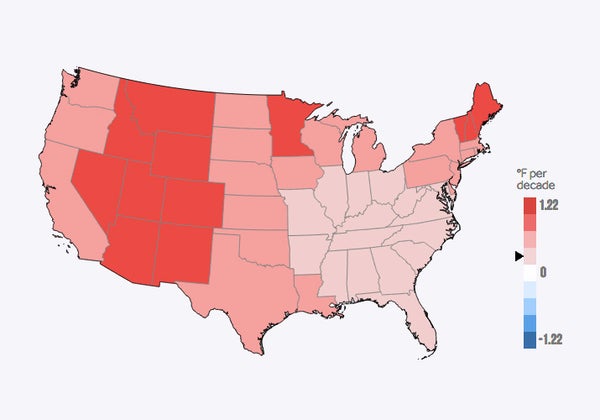
While the heat is unusual in its magnitude, warmer winters in the U.S. are becoming the rule, not the exception. It’s the fastest-warming season for 37 states that roughly 220 million people call home.
On supporting science journalism
If you're enjoying this article, consider supporting our award-winning journalism by subscribing. By purchasing a subscription you are helping to ensure the future of impactful stories about the discoveries and ideas shaping our world today.
Climate change is driving up the temperature around the year and around the globe, but topography, weather patterns and snow cover — among other factors — yield regional differences for warming.
In the U.S., that means winters are warming fastest from Montana to Florida, springs are cranking up the quickest in the Southwest, and falls are feeling the heat in the Northwest. Then there’s the Lone Star State as the lone place where summer is warming the fastest.
If you look at all four seasons across all of the Lower 48 states — for a grand total of 192 state-season combinations — there are only three instances of cooling. The Dakotas and Iowa are cooling ever so slightly in summer.
Otherwise, there’s only one direction temperatures have gone: up.
Snow cover in particular plays a role in why winters are heating up so fast from Montana to North Carolina. Or more specifically, it’s a lack thereof.
As temperatures rise, snow is decreasing — and in many cases being replaced by rain. Replacing light snow with dark ground means more of the sun’s energy is absorbed leading to a faster increase in warming.
In the Southwest and California, where spring is the fastest-warming season, a similar pattern could be playing out as spring snowpack melts earlier.
Melting snow also represents a potential feedback loop that could send winter and spring temperatures soaring even higher. More dark ground is exposed as snow disappears, which leads to even more warming and more snow disappearing.
And in the Northwest, falls are heating up fastest since 1970. Research published in 2014 indicates that the increased seasonal warmth is likely driven by changes in the Pacific-North American pattern and El Niño, two climate oscillations that can have strong impacts on the region.
There will continue to be regional and seasonal differences in trends across the U.S. (and the world for that matter). Despite those differences, climate change will overwhelming contribute to rising temperatures in the coming years and decades, regardless of what season it is.
This article is reproduced with permission from Climate Central. The article was first published on February 17, 2016.