
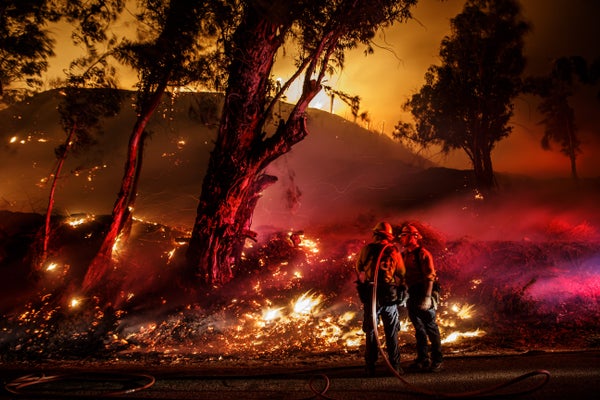
Firefighters plan to take an unusually aggressive approach to battling wildfires this year in an effort to avoid mass evacuations and encampments during the coronavirus pandemic.
State fire officials told members of Congress yesterday that their goal is to suppress wildfires quickly to forestall the need for large evacuation shelters and sprawling base camps for firefighters at a time when the risk of contracting the virus remains high.
"The key for all of us is to have an aggressive initial attack. Keep fires small," Thom Porter, chief of the California Department of Forestry and Fire Protection (Cal Fire), told a group of House Democrats who held a forum on how the pandemic will affect wildfire suppression.
On supporting science journalism
If you're enjoying this article, consider supporting our award-winning journalism by subscribing. By purchasing a subscription you are helping to ensure the future of impactful stories about the discoveries and ideas shaping our world today.
"We will continue to look at ways to reduce our large incidents and the need for large base camps. That's going to be the most critical thing," Porter said. Cal Fire also wants to minimize the need for large shelters that have handled hundreds of people fleeing past wildfires in California.
The aggressive strategy means that fire departments will avoid letting some wildfires burn to improve forest health in the long term. Research has shown that managing fire with minimal suppression makes wilderness areas more resilient to catastrophic blazes by diversifying the vegetation and increasing water storage.
"From time to time we try to allow a fire to be managed for resource benefits," Mike Morgan, director of the Colorado Division of Fire Prevention and Control, told House Democrats.
But not this year.
"When you add the complexities of coronavirus and COVID into that equation, that just comes off the table. That is not even an option. The risks are just too great," Morgan said. "We're trying to do a lot of work to make sure that we catch those fires early on."
The National Interagency Fire Center said last week that "significant large fire potential" is expected in July across a wide swath of the western U.S., stretching from New Mexico, through Arizona, Utah, Nevada, Northern California and into Idaho, Oregon and Washington.
In August and September, the areas with significant wildfire potential will be concentrated in Northern California, northwestern Nevada, Oregon, Washington and western Montana, the fire center wrote in its June wildfire outlook.
The forum yesterday comes as House Democrats try to build support for a $3 trillion tax cut and spending bill that includes money for states and localities to retain firefighters and other public employees. The measure faces opposition from Senate Republicans and President Trump over its cost.
New Mexico State Forester Laura McCarthy told yesterday's forum that federal money will help firefighting this year.
"To keep fires small, we also need the support of annual appropriations for state fire assistance, which prepares states for aggressive initial attack through activities that range from training to contracts for aircraft," McCarthy said.
The remote session yesterday was not a committee hearing and was attended only by Democrats on the House Natural Resources Committee and fire officials from states with Democratic governors.
Reprinted from Climatewire with permission from E&E News. E&E provides daily coverage of essential energy and environmental news at www.eenews.net.