
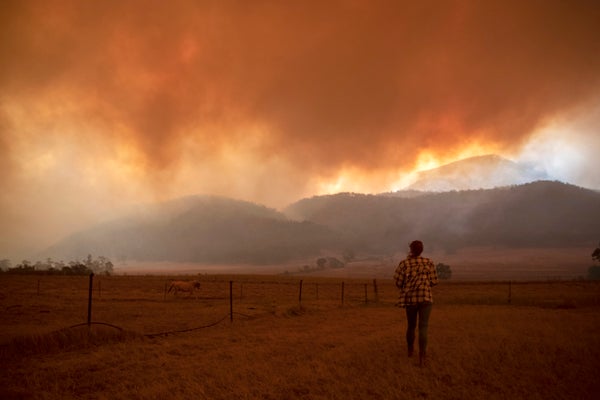
Bush fire season is underway again in Australia, where summer has just kicked off. Yet the country is still recovering from record-breaking wildfires two years ago that killed at least 33 people, destroyed thousands of homes and burned more than 65,000 square miles of land.
How quickly the natural landscape recovers depends on the climate over the coming years. It might take a couple of decades under average conditions. But if the weather stays hot and dry—and if more extreme wildfires occur in the meantime—the ecosystem might never get back to normal.
That’s the takeaway from a
On supporting science journalism
If you're enjoying this article, consider supporting our award-winning journalism by subscribing. By purchasing a subscription you are helping to ensure the future of impactful stories about the discoveries and ideas shaping our world today.
study published last month in AGU Advances that examined the impact of the record-breaking blazes on the Australian carbon cycle.
These fires likely released somewhere around 186 million tons of carbon into the atmosphere, the research found. It’s a staggering amount—more than the entire country emits in a typical year by burning fossil fuels.
Ordinarily, it would probably take the landscape about 20 years to soak all that carbon back up again, as trees and other plants gradually begin to grow back. But climate change presents a problem: The weather in Australia is getting hotter, and the risk of drought is growing stronger.
That could slow things down—potentially indefinitely.
“It’s getting warmer and drier, so it can take longer to recover from fires—plus, you’re having more fires,” said Brendan Byrne, a postdoctoral researcher at NASA’s Jet Propulsion Laboratory and the lead author of the new study. “That’s a concern that we’re causing permanent carbon losses in these areas.”
Under typical conditions, Australia’s forests and grasslands act as a carbon sink—they soak up carbon dioxide from the atmosphere and store it away. That makes them a valuable climate resource. When these landscapes are stressed or damaged, on the other hand, they can release carbon back into the air.
Byrne and the other researchers, from institutions in the United States, Australia and New Zealand, examined the impact of both drought and wildfires on the Australian ecosystem during the 2019-20 bush fire season. They conducted the study using satellite observations, which monitor carbon dioxide and other greenhouse gas concentrations in the atmosphere.
The study found that the bush fires more than doubled Australia’s annual carbon footprint.
In a typical year, Australia emits around 104 million metric tons of carbon through the burning of fossil fuels. The fires in 2019 and 2020, plus the added effects of drought, added an extra 186 million tons on top of it.
That’s in line with estimates from other research.
Since the record-breaking season, several other studies have attempted to quantify the amount of carbon the bush fires produced. Some of them used different methods—they looked at the total amount of land burned by the blazes and then estimated the emissions based on that burned area. Yet they came to similar conclusions.
The fact that these bottom-up estimates largely agree with the top-down estimates produced by satellite observations means that scientists now have “quite a bit of confidence in what these emissions actually were,” according to Byrne.
Byrne and his colleagues also looked at how the Australian landscape recovers under different conditions.
When forested areas are struck by drought, they tend to lose some carbon. But when the weather grows cooler and wetter again, they tend to bounce back quickly. Areas that have been burned by wildfires, on the other hand, recover from drought much more slowly.
That means both drought and fire can compromise the land’s ability to soak up carbon from the atmosphere. And global warming is increasing the odds of both.
Based on their observations, the researchers estimate that it should take about 21 years for the Australian ecosystem to soak up all the carbon it lost in the 2019-20 bush fires. That’s under average conditions. In a cooler, wetter climate, it could be done in a decade or so.
On the other hand, if the climate grows hotter and drier, some of that carbon might never be regained. That’s especially likely if more wildfires keep interrupting the recovery process.
The study highlights several growing concerns among scientists about climate change and natural ecosystems. As certain parts of the Earth heat up, dry out and burn more easily, they may emit more and more carbon into the atmosphere. That could speed up the rate of global warming even further.
Satellite studies are one way to keep an eye on these kinds of events, Byrne noted.
At the same time, as the Earth continues to warm, some landscapes may be dramatically—and irreversibly—altered.
“This is something people are really worried about—you end up in some kind of transition to a different type of ecosystem,” Byrne said. “That’s the kind of real concern in this area.”
Reprinted from E&E News with permission from POLITICO, LLC. Copyright 2022. E&E News provides essential news for energy and environment professionals.