
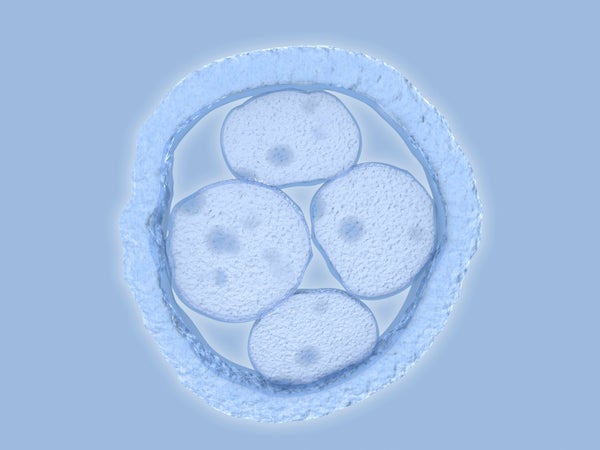
In a step that some of the nation’s leading scientists have long warned against and that has never before been accomplished, biologists in Oregon have edited the DNA of viable human embryos efficiently and apparently with few mistakes, according to a report in Technology Review.
The experiment, using the revolutionary genome-editing technique CRISPR-Cas9, was led by Shoukhrat Mitalipov of Oregon Health & Science University. It went beyond previous experiments using CRISPR to alter the DNA of human embryos, all of which were conducted in China, in that it edited the genomes of many more embryos and targeted a gene associated with a significant human disease.
“This is the kind of research that is essential if we are to know if it’s possible to safely and precisely make corrections” in embryos’ DNA to repair disease-causing genes,” legal scholar and bioethicist R. Alta Charo of the University of Wisconsin, Madison, told STAT. “While there will be time for the public to decide if they want to get rid of regulatory obstacles to these studies, I do not find them inherently unethical.” Those regulatory barriers include a ban on using National Institutes of Health funding for experiments that use genome-editing technologies in human embryos.
On supporting science journalism
If you're enjoying this article, consider supporting our award-winning journalism by subscribing. By purchasing a subscription you are helping to ensure the future of impactful stories about the discoveries and ideas shaping our world today.
The first experiment using CRISPR to alter the DNA of human embryos, in 2015, used embryos obtained from fertility clinics that had such serious genetic defects they could never have developed. In the new work, Technology Review reported, Mitalipov and his colleagues created human embryos using sperm donated by men with the genetic mutation that they planned to try to repair with CRISPR. The embryos are described as “clinical quality.” A 2017 experiment, also in China, used CRISPR to edit DNA in normal, presumably viable fertilized eggs, or one-cell human embryos.
Also in contrast to the experiments in China, those led by Mitalipov reportedly produced very few “off-target” effects, or editing of genes that CRISPR was supposed to leave alone. And the experiment avoided what is called “mosaicism,” in which only some cells of an embryo have the intended DNA changes. The embryos were not allowed to develop beyond a very early stage.
Read more:First he pioneered a new way of making life. Now he wants to try it in people
Because changing the DNA of an early embryo results in changes to cells that will eventually produce sperm and eggs, if the embryo is born and grows to adulthood, any children he or she has will inherit the genetic alteration, which is called germline editing. That has led to fears that such manipulations could alter the course of human evolution.
It has also triggered warnings about “designer babies,” in which parents customize their IVF embryos by adding, removing, or changing genes for certain traits.
A recent report on genome editing from the National Academies did not call for a moratorium on research into germline editing, arguing that it might one day be a way for some parents to have healthy, biological children, such as when both mother and father carry genetic mutations that cause severe diseases.
“But we anticipated that there would need to be a lot of research to see if you could make these changes without any unintentional effects,”said Charo, who co-chaired the Academies committee. Mitalipov, who did not respond to requests for comment, has now shown that the answer to that might be yes.
Some scholars questioned how important the new study is, however. Stanford University law professor and bioethicist Hank Greely tweeted that “the key point” is that no one has tried to implant any edited embryos. “Research embryos” that are “not to be transferred for possible implantation” are “not a big deal,” he argued.
Republished with permission from STAT. This article originally appeared on July 26, 2017