
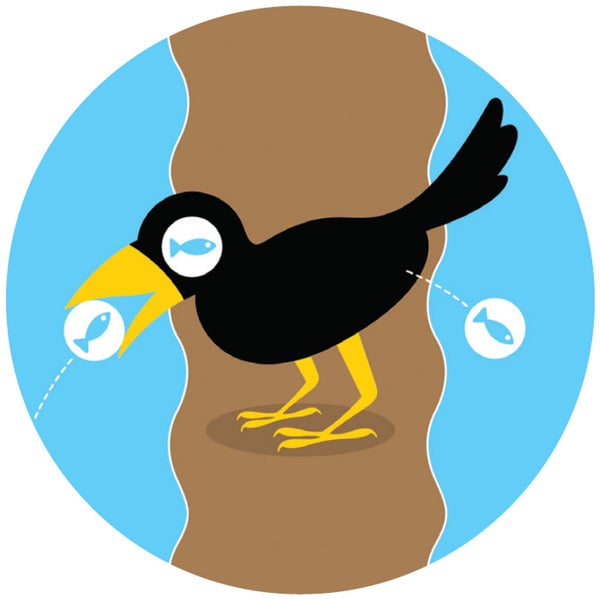
For centuries scientists speculated that fish eggs reached isolated lakes and ponds by hitching rides on water birds' feathers or feet. But according to findings published in July in the Proceedings of the National Academy of Sciences USA, the mode of transport for at least some eggs could be much more intimate: the new research provides the first evidence that soft-membraned fish eggs, eaten and pooped out by birds, can still hatch into viable young.
“No one ever really thought of bird guts before because I think it's quite an absurd thing,” says co-author Orsolya Vincze, an ecologist at the Danube Research Institute in Debrecen, Hungary. “We were hopeful we'd find something, but we still thought it was pretty unlikely.” Researchers did hatch a killifish egg from swan excrement in 2019—but killifish eggs are unusually hardy, able to withstand extended periods of dehydration.
Vincze and her colleagues hypothesized that ordinary fish eggs might be able to survive being eaten after the study's first author, Ádám Lovas-Kiss, observed that soft plant material stayed alive in bird feces.
On supporting science journalism
If you're enjoying this article, consider supporting our award-winning journalism by subscribing. By purchasing a subscription you are helping to ensure the future of impactful stories about the discoveries and ideas shaping our world today.
To test their hunch, the researchers acquired eight captive-bred mallard ducks from a local breeder and the eggs of two carp species from an aquaculture institute. They force-fed each duck three grams of fertilized eggs (about 500 eggs per serving) from each fish species over two separate experiments. Examination of the birds' feces revealed 18 whole eggs, which the investigators placed in an aquarium. Twelve had viable living embryos, and three hatched into normal baby fish.
“For me, this research shows that there are scientific questions that can yield insightful results, while being implemented within simple, easy-to-understand and [easy-to-]reproduce experimental setups,” says Tibor Hartel, an ecologist at Babeş-Bolyai University in Romania, who was not involved in the study.
Vincze and her colleagues suspect the success rate would be higher in the wild, where conditions are more favorable for keeping eggs healthy; they hope to test this idea in future experiments. They also plan to conduct follow-up studies on a more diverse set of fish species.