
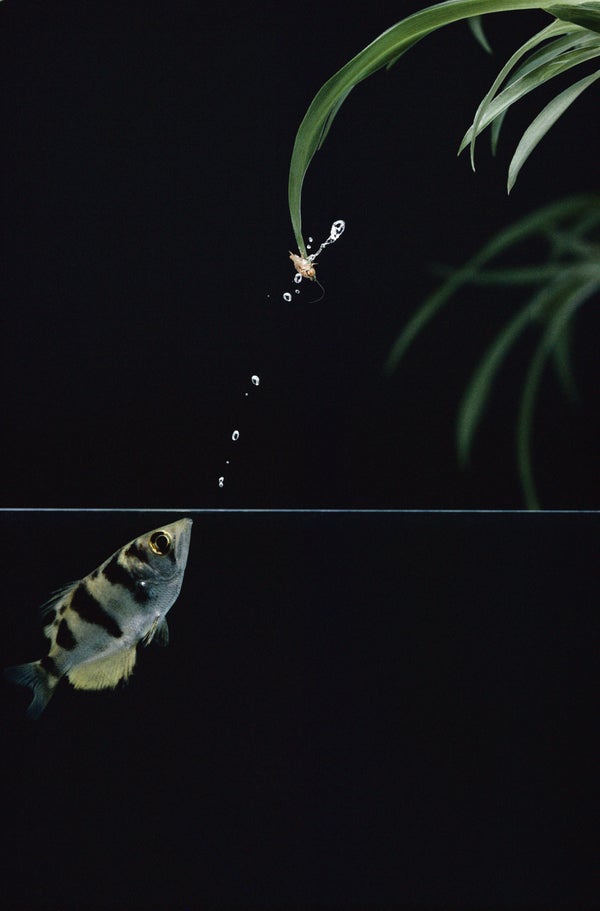
University of Oxford zoologist Cait Newport suspected the archerfish she was studying could recognize her. The tropical fish—known to spit jets of water at insect prey—would take aim at her when she walked into the laboratory.
Newport and her colleagues showed in 2016 that her fish could indeed remember human visages. She trained them to spew water at a head-on view of a specific computer-rendered face, which they picked out 77 to 89 percent of the time. But the researchers did not know what would happen if the fish encountered a familiar face from unfamiliar angles. Now, in a study described last November in Animal Behaviour, they have demonstrated that the fish can recognize the same face turned to the side by 30, 60 and 90 degrees—a nontrivial task.
The experiments were intended to probe how fish perceive three-dimensional objects, and faces are particularly interesting examples. “They’re complicated, they’re quite difficult to [process] even for computers and people—and when you rotate them, they change in a really interesting way,” Newport says.
On supporting science journalism
If you're enjoying this article, consider supporting our award-winning journalism by subscribing. By purchasing a subscription you are helping to ensure the future of impactful stories about the discoveries and ideas shaping our world today.
For humans, face recognition happens in the cerebral cortex, the area of the mammalian brain responsible for higher cognition. Newport’s research shows that an animal without a cortex can still distinguish a human face. “If fish are able to do these really complicated visual tasks with a really small brain, then maybe we can come up with different engineering solutions” for face-recognition technology, she says.
Fish are smarter than people give them credit for, says Vera Schluessel, a zoologist at the University of Bonn in Germany, who was not involved in the new study. “People always say that because something is older, it is more primitive. It’s quite the opposite,” Schluessel says. Archerfish might have different brain machinery from humans, but they are still able to extrapolate how objects might look from different angles—a crucial skill for hunting, navigating and spotting predators.
Schluessel’s team and others have highlighted the visual capabilities of other fish: grey bamboo sharks can recognize shapes and navigate mazes from memory; the Ambon damselfish can see ultraviolet patterns invisible to humans on the faces of other fish; and angelfish can count. Now that we know some fish see us more clearly than we thought, maybe that should change how we see them.