
On supporting science journalism
If you're enjoying this article, consider supporting our award-winning journalism by subscribing. By purchasing a subscription you are helping to ensure the future of impactful stories about the discoveries and ideas shaping our world today.
Do my eyes deceive me or is a fish gene waving from inside a mouse embryo's paw? Well, to be precise, it is not exactly a fish gene: it is a genetic switch called CsB with analogs in a variety of animals, including humans. Oh, and it suggests that a DNA sequence that makes limb development possible was present in fish long before they crawled up on land.
DNA is littered with genetic switches, sequences that determine when a gene should be expressed and when it should be ignored. For example, there are sections of human DNA that make the ends of a human embryo's limbs develop into hands and feet. If these genes were active in cells other than those at the ends of limbs, then human babies would be born with fingers in very odd places. Instead, CsB acts as an on/off switch for the limb-development genes, switching them on for cells in the extremities and off for more central cells.
CsB, however, is not limited to humans. A related sequence can be found in the DNA of other animals, including mice and a type of fish called a skate. Like their close relatives, rays, skates are flat, cartilaginous fish with eyes perched on top of their body and gills on their underside. "In skates, the switch is present; it has comparable activities with the mammalian switch, but there are differences," says lead author Igor Schneider of the University of Chicago.
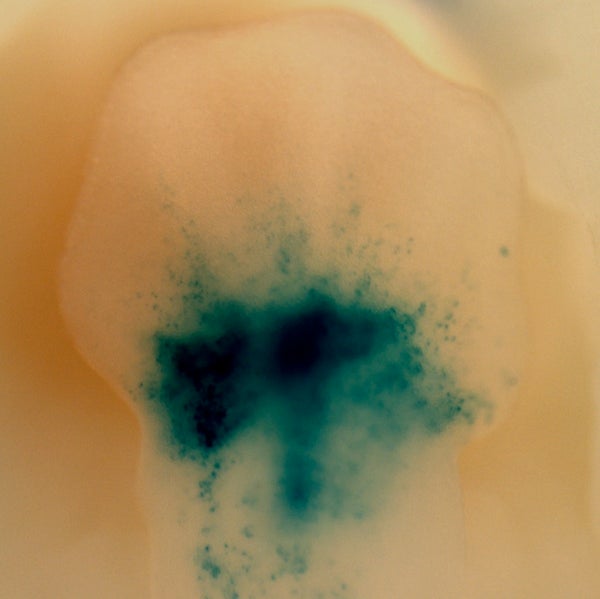
In order to determine whether a mouse's body would recognize the skate's CsB switch, Schneider and the rest of the research team, which published its results on July 11 in Proceedings of the National Academy of Sciences, put the skate switch into a mouse embryo. If the embryo's DNA activated the skate switch, then the triggered gene would go active at the ends of the embryo's developing limbs. The researchers attached a special gene to the switch so that, on activation, it would produce a blue color when exposed to a certain chemical.
As this image of the mouse embryo's paw shows, CsB turned "on" in the mouse's extremities, triggering the activation of the gene and the production of the blue splotch—even though the CsB in question came from a skate's genetic code. The CsB's ability to function in both mice and skates suggests that the antecedents of fully developed limbs existed early on the evolutionary tree.
"These switches were only thought to develop when animals moved up onto land, but they actually were present a long time ago," Schneider says. Limbs did not arise from scratch but rather built on pre-existing genetic code, eventually developing from fins in fish into more dexterous appendages in land mammals.
--Sophie Bushwick