If you're enjoying this article, consider supporting our award-winning journalism by subscribing. By purchasing a subscription you are helping to ensure the future of impactful stories about the discoveries and ideas shaping our world today.
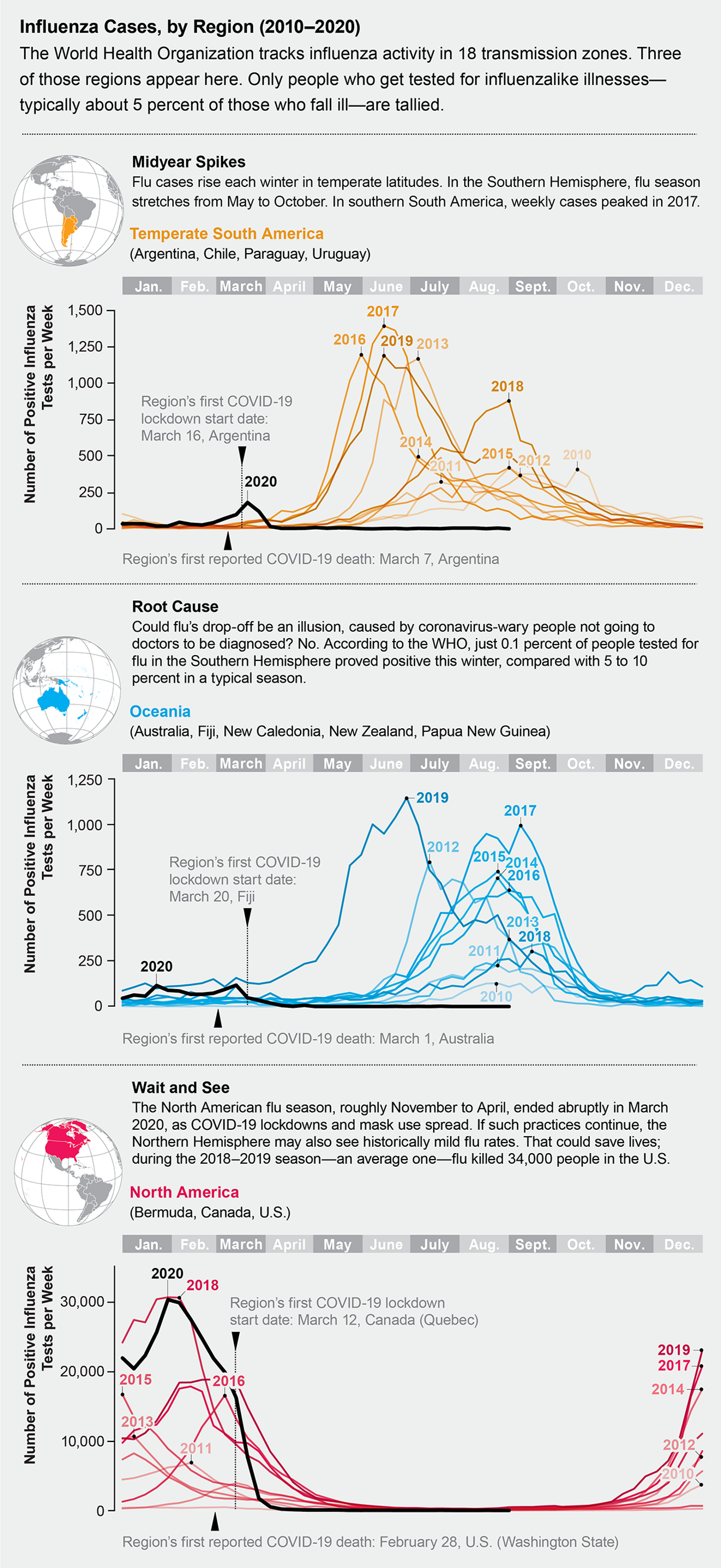
In March, as coronavirus widened its global sweep, one health statistic quickly flattened: influenza cases. In the Southern Hemisphere, flu season would have been just taking off, but cases were virtually nonexistent. “Never in my 40-year career have we ever seen rates ... so low,” says Greg Poland, an influenza expert at the Mayo Clinic. Although researchers need to study the reasons further, several told Scientific American that coronavirus prevention measures—handwashing, mask wearing and social distancing—are working against flu transmission. If those measures continue, Poland says, countries could see the most dramatic drop in influenza cases in modern human history. U.S. health experts still recommend flu shots, however, because not everyone in the country is observing measures to contain the virus and because COVID-19 could perhaps be more threatening in people who contract flu.
Credit: Katie Peek; Source: FluNet/Global Influenza Surveillance and Response System, World Health Organization (influenza rates)
Subscribe to Support Independent Journalism
Great science journalism requires human expertise, time, effort and creativity. And it costs money. That’s why I and the journalists here at Scientific American hope you’ll join our community.
When you subscribe, you are supporting staff and freelance journalists who are passionate about telling science stories that are true, important and compelling. Our editors and reporters are often experts in their fields, which means they understand the nuances of big discoveries and can untangle the breakthroughs from the hype. With a subscription, you are also supporting rigorous fact-checking to ensure the words we publish are precise and accurate. And you’re supporting original illustrations, graphics and photos that bring you closer to an advanced laboratory, an ice sheet in Antarctica or a space mission in orbit. You’re helping us craft other types of high-quality journalism as well: Our newsletters are carefully written, edited and curated by staffers you have or will come to know and love. Our Science Quickly podcast is based on original reporting, collaboration with editors and scientists and exacting production.
Subscriptions keep this engine running so we can continue to deliver thoughtful, rigorous and independent science journalism to you. In an era of viral misinformation, this work is crucial. If you value what we do, I hope you’ll consider joining us as a subscriber
Thank you,
Jeanna Bryner, Editor in Chief, Scientific American