
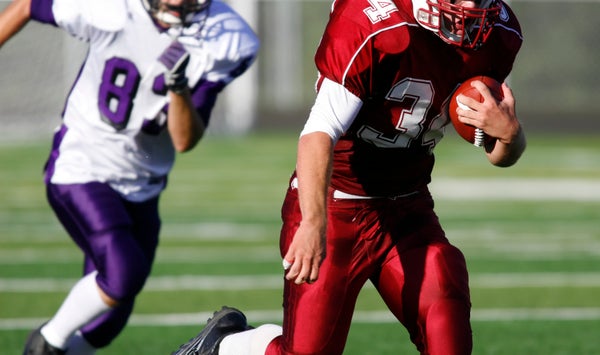
Kinematics, the study of motion and how things move, encompasses the concepts of position, velocity and acceleration—but as anyone who has caught up to someone in a game of tag or on the running track knows, it's acceleration that's the most fun element of this concept.
Some of us start out slow, but acceleration can yield some surprising results when it comes to predators and prey, or basically anyone involved in a chase. As the kinematics episode of NBC Learn's "The Science of NFL Football" states, "NFL running backs would be easy prey, and football itself wouldn't be nearly as fun to watch" without acceleration and other aspects of kinematics.
Football players, track runners, prey eluding predators—all basically want to reach their top velocities, or accelerate, as quickly as possible.
On supporting science journalism
If you're enjoying this article, consider supporting our award-winning journalism by subscribing. By purchasing a subscription you are helping to ensure the future of impactful stories about the discoveries and ideas shaping our world today.
So here's a brain puzzle to help you work through this issue. Take a look at the graph below, which shows the velocities of a gazelle (the prey) and a lion (the predator) over time. Velocity in meters per second is on the y axis (vertical) and time in seconds is on the x axis (horizontal).
Which of the following is true for a lion attempting to catch a gazelle?
A. The lion should chase the gazelle for as long as possible to maximize the chance of catching it.
B. The lion should chase the gazelle until the gazelle reaches its maximum velocity.
C. The lion should give up the chase if he hasn't caught the gazelle within four seconds.
D. The gazelle doesn't have to worry about lions, because it can run about twice as fast.
E. The gazelle travels farther than the lion does in the first two seconds of the chase.
Now imagine that the lion is a linebacker and the gazelle is a fleet-footed running back. In the 40-yard dash, the running back always beats the slower linebacker. But in real games, the linebacker has a chance to make the tackle if he can accelerate faster than the running back—yet if he doesn't catch him in the first four seconds, he may as well forget it. (The correct answer is C.)
Of course the situation works the other way, too—a slower running back could elude a swifter defensive back if he can accelerate fast enough, perhaps reaching the end zone before the defender can catch him. As former New Orleans Saints running back "Deuce" McAllister explains in the video, "You're going to beat him to his top speed, therefore you're going to be more successful than he is." Acceleration can make you a winner, even if your opponent can ultimately run faster than you.
The graph is courtesy of J.A. Bolker and D.C. Meredith, University of New Hampshire, and is based on data from Elliott, P.; Cowan, I. M.; and Holling, C. S., 1977. Prey capture by the African lion. Canadian Journal of Zoology 55(11):1811-1828.