
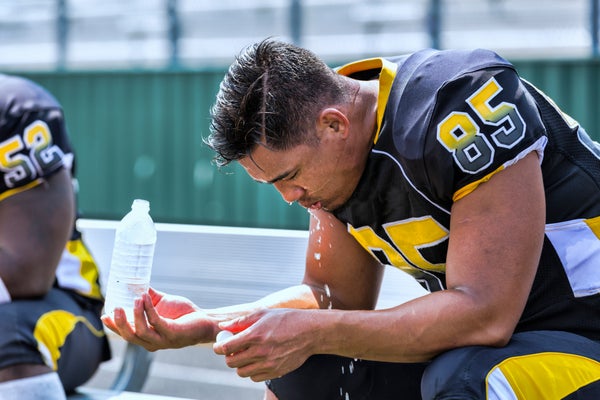
To reach the pro level, football players must compete aggressively. But to keep charging ahead at full steam, they also need to be vigilant about their health, which means eating and drinking right. In this extreme sport, just how much water can these pro athletes sweat through?
The body loses moisture through perspiration as well as through respiration (think of your breath fogging a window). Both of these processes speed up during exercise as the body works to cool itself down with sweat, which evaporates from the skin, taking heat with it, and by breathing harder to get extra oxygen to the muscles. Pile these factors on to a hot summer training session under heavy protective gear, and you have a recipe for some serious fluid loss.
To estimate for the amount of moisture lost, trainers subtract a player's postgame weight from his pregame weight. The difference is approximately how much fluid they have lost—and not yet replaced.
On supporting science journalism
If you're enjoying this article, consider supporting our award-winning journalism by subscribing. By purchasing a subscription you are helping to ensure the future of impactful stories about the discoveries and ideas shaping our world today.
Athletic trainers usually try to make sure players don't lose more than about 3 percent of their overall weight during a practice session (although some may lose more). So, a running back might drop four to five pounds (around two kilograms) during a game, and a lineman might expend closer to nine pounds (four kilograms), says Chris Fischetti, an athletic trainer for the Buffalo Bills.
If a 300-pound (135-kilogram) lineman loses about 3 percent of his body weight, he has sweat out 1.08 gallons (4.09 liters) of fluid—which means that he would need to drink about 17 eight-ounce (23.5-centiliter) glasses of water to rehydrate after the game. That's a good deal more than the daily water intake recommendations for physically active adults, which are currently set at the equivalent of about 15 eight-ounce glasses for men and about 11 for women. Athletic trainers encourage the players to keep drinking fluids throughout games and practices, even if the athletes don't feel thirsty.
But water doesn't just come from the tap. Many foods, such as fruits and vegetables, also provide fluids and generally make up about a fifth of people's total daily water consumption.
And pro athlete or not, getting enough fluids is important because dehydration can lead to suboptimal performance, and in extreme cases lightheadedness and loss of consciousness. And when coupled with high temperatures and high humidity, such as those often experienced during intense NFL summer training camps, the body can overheat, leading to heat exhaustion or heat stroke—a serious medical condition.
