
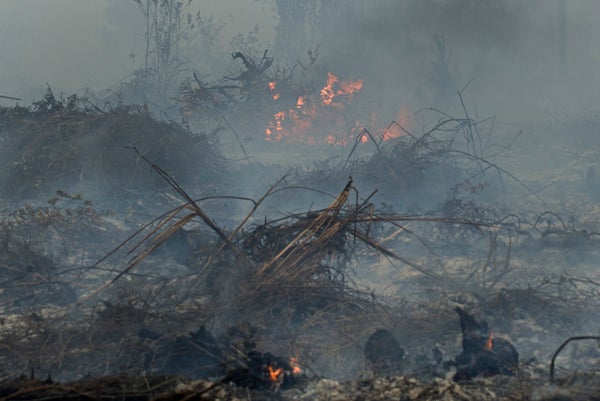
OSLO (Reuters) - Forest fires in Brazil and Indonesia contributed to a record loss in global tree cover in 2016, equivalent to the size of New Zealand, that could accelerate deforestation blamed for climate change, an independent forest monitoring network said on Monday.
Man-made global warming increased the risks of wildfires by adding to extreme heat and droughts in some regions, according to Global Forest Watch (GFW). This year, California and Portugal have been among places suffering deadly blazes.
The combination of forest fires with land use change and climate change could speed destruction in areas like the Amazon and contribute to emissions of carbon dioxide, one of the gases that contribute to global warming, the report said.
On supporting science journalism
If you're enjoying this article, consider supporting our award-winning journalism by subscribing. By purchasing a subscription you are helping to ensure the future of impactful stories about the discoveries and ideas shaping our world today.
Worldwide, global tree cover losses rose 51 percent in 2016 from the previous year to 297,000 square kilometers (114,672 square miles), according to data from the University of Maryland compiled by Global Forest Watch (GFW).
That was a record high for GFW records stretching back to 2000, and contrasted with some other satellite measurements that indicated a slowdown in the pace of forest clearances to make way for farms, cities and roads.
“We saw quite a dramatic spike in 2016,” said Mikaela Weisse, research analyst at the U.S. think-tank World Resources Institute which oversees GFW. “That seems to be related to forest fires in countries including Brazil, Indonesia and Portugal.”
GFW measures loss of tree cover and does not estimate net changes in forests to take account of re-growth and new plantings.
By contrast, the U.N.’s Food and Agriculture Organization, using different methods, says the net global rate of deforestation has slowed by more than 50 percent in the last 25 years.
GFW said Brazil’s Amazon region lost 37,000 square kilometers of tree cover in calendar 2016, almost three times more than in 2015.
That contrasts with official Brazilian data showing that deforestation in the Amazon fell 16 percent in August 2016 to July 2017 compared with the same period a year earlier. Brazil said it was the first decline in three years.
Brazil’s environmental agency Ibama said 2016 was the ninth-worst year for forest fires since monitoring began in 1998.
“The dry climate and low humidity made man-made fires gain larger dimension,” Ibama said in an email.
Weisse said GFW data often detected smaller-scale losses in tree cover, including in layers beneath the forest canopy, while the Brazilian data was better at recording clearances of large blocks of forest.
GFW said Indonesia lost almost 1 million hectares of tree cover in 2016, probably the delayed result of a severe fire season in 2015.