
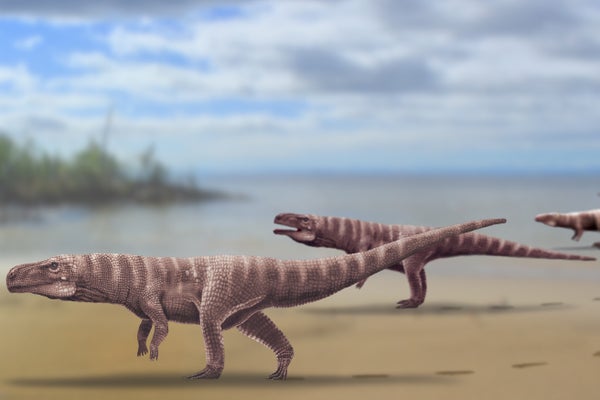
More than 113 million years ago, a strange reptile lived in what is now South Korea. It strode around on two legs like many dinosaurs, yet it was not one of them. The tracks it left behind indicate it was a relative of today’s crocodiles. And the details of its Cretaceous footfalls resolve one mystery—but open another.
Footprints like these had been found before, though in much older rocks. During the Triassic period (between 252 million and 201 million years ago) crocodile relatives—part of a group known as crocodylomorphs—were the dominant reptiles on land, and they included animals that resembled some dinosaurs by walking on two legs. These forms went extinct at the end of the period, yet the geologically younger tracks from South Korea’s Jinju Formation represent a bipedal crocodylomorph that lived long after the Triassic closed.
Paleontologist Kyung Soo Kim of Chinju National University of Education in South Korea, fossil footprint expert Martin Lockley of the University of Colorado Denver and their colleagues describe the puzzling fossil tracks in a paper published on Thursday in Scientific Reports.
On supporting science journalism
If you're enjoying this article, consider supporting our award-winning journalism by subscribing. By purchasing a subscription you are helping to ensure the future of impactful stories about the discoveries and ideas shaping our world today.
Lockley calls South Korea a “tracker’s heaven” for paleontologists because of the sheer number of fossil footprints found in the country. Last November, he says, Kim had asked for his opinion on large Cretaceous tracks uncovered at the site. The prints looked similar to those attributed to pterosaurs, flying reptiles from the Age of Dinosaurs, that were walking on the ground. But Lockley recognized them as something else. “I immediately saw that they were of the type known as Batrachopus,” or a form of track attributed to crocodile relatives from the early part of the Jurassic (201 million to 145 million years ago). These footprints not only were much larger than any other known Batrachopus tracks, but they also indicated that the animals at the site walked on two legs—and were present for millions of years more in the Cretaceous period.
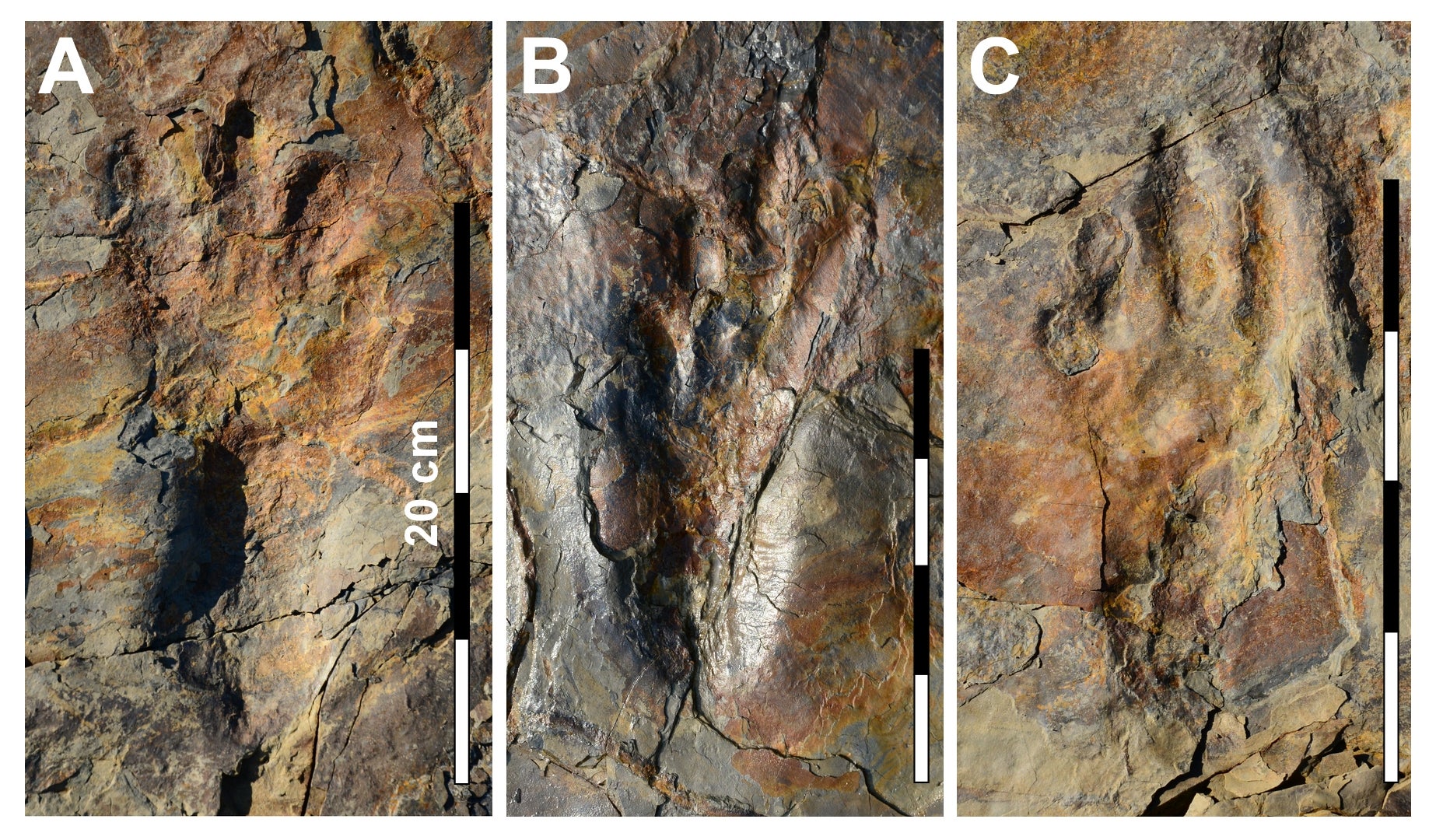
Photographs of well-preserved tracks of the extinct crocodile relative. Credit: Kyung Soo Kim Chinju National University of Education, Kyungnam, South Korea
The presence of bipedal crocs at the fossil site was unexpected. The discovery does help address another fossil mystery, however. At a different South Korean location known as Gain-ri, there are tracks that were also previously believed to be left by large pterosaurs. Tracks found elsewhere in the world indicate that the flying reptiles folded their wings to waddle on all fours while on the ground. But researchers had thought the prints at Gain-ri were made by pterosaurs that moved on two legs to avoid dragging their wings through the muck.
The new fossils have changed the analysis of these tracks—and have undercut interpretations of pterosaurs walking on two legs at other sites. Pterosaur expert Liz Martin-Silverstone of the University of Bristol in England, who was not involved in the new study, agrees that the presumed “pterosaur” tracks at Jinju look much more like prints made by crocodile relatives than those left by pterosaurs. In fact, she notes, “all previously described bipedal ‘pterosaur’ trackways have come out as crocodilian upon reexamination”—which dovetails with skeletal evidence indicating these prehistoric flappers tottered around on four legs while on the ground.
Such cases of mistaken identity can happen because the way moving creatures make footprints is much more complex than it may initially seem. “The tracks produced can change significantly, depending on things like what the animal was doing at the time the track was made, the nature of the substrate, where the center of gravity was and what type of gait it had,” Martin-Silverstone says. This situation means one animal can sometimes make tracks that look like those of another.
With the new find, paleontologists now know of at least two fossil sites that apparently record the bipedal footsteps of Cretaceous crocodylomorphs—not those of pterosaurs acting unusually. “This new footprint evidence shows we have to rethink the crocs of yesteryear and regard some as agile land dwellers,” Lockley says. Although crocodiles are often cast as “living fossils” that have changed little since their origin in the Triassic, skeletal and track evidence has shown that crocs in the Age of Dinosaurs were varied, active animals that often looked very different from the swimming ambush predators we are familiar with today. But what exactly did the ones that made the Jinju tracks look like?
So far no skeletons of crocodylomorphs capable of walking this way have been found in the same rocks as the tracks in the new study. But older fossils may give paleontologists an idea of what kind of fossils to look for. During the Triassic period, a bipedal crocodile relative named Postosuchus roamed North America and was capable of making tracks similar to those found in South Korea. Either a long-lost representative of this group survived—or crocodylomorphs evolved to walk on two legs a second time. If the fossil record is kind to paleontologists, they may someday be able to match footprints to bones.