
The National Climate Assessment wasn’t the only global warming report the Trump administration quietly released over the Thanksgiving holiday.
The U.S. Geological Survey reported Friday that about one-quarter of all U.S. carbon emissions come from fossil fuels extracted from public lands.
Environmentalists reacted by renewing calls to end leasing for oil, gas and coal leasing on federal tracts.
On supporting science journalism
If you're enjoying this article, consider supporting our award-winning journalism by subscribing. By purchasing a subscription you are helping to ensure the future of impactful stories about the discoveries and ideas shaping our world today.
Between 2005 and 2014, an average of 23.7 percent of American carbon dioxide emissions came from energy produced on public lands. That includes the emissions generated by drilling, mining, transporting and refining fuel before it’s burned.
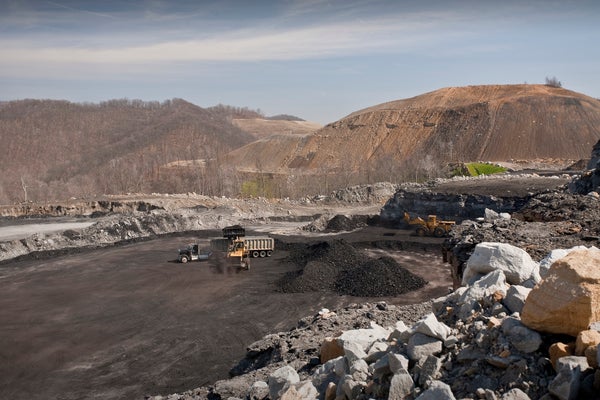
Commissioned in 2016 by the Obama administration, the report found that coal is mostly responsible for those emissions, with coal-fired power plants alone accounting for nearly 60 percent of public lands’ carbon emissions.
In other words, coal mined on public lands accounted for more than 13 percent of U.S. emissions over the past decade.
Public lands are also significant sources of the powerful greenhouse gases methane (7.3 percent of total U.S. emissions) and nitrous oxide (1.5 percent).
David Hayes, who was President Obama’s deputy Interior secretary, wrote on Twitter that the report confirmed mining and drilling public lands is driving serious emissions, yet the Trump administration is promoting policies that will make it worse.
Interior is pushing out large volumes of fossil fuel lease sales while also rolling back regulations on methane, which drives steep warming over the short term. The department has said these moves have put 230,000 more people to work while creating billions of dollars in new wealth (Greenwire, Nov. 14).
Taylor McKinnon of the Center for Biological Diversity said the report shows how important it is to move in the opposite direction.
"One of the first and best ways to respond is to end new fossil-fuel leasing on public lands. That will help reduce threats to the climate, clean air and water, endangered wildlife and wild places. Ending public lands leasing programs must be a pillar of any serious climate plan moving forward," he said in a statement.
It’s not clear how much President Trump’s policies could change emissions.
The report showed emissions peaking around 2009 before decreasing about 6 percent. The Trump administration has overseen a bounce in coal mined on federal lands—but the amount mined in fiscal 2017 was still less than all but one year under Obama, according to Interior data.
Among the report’s other findings:
Of 28 states where energy is extracted from public lands, as well as the offshore Gulf of Mexico and Pacific regions, more than half the carbon emissions—57.7 percent—come from Wyoming alone. The Gulf was second, with 19 percent.
Public lands sequester about 15 percent of the emissions that originate there.
Wildfire caused public lands to lose 67 million metric tons of sequestered carbon over the past decade—nearly a fifth of the total. Most of those losses came from Alaska. By comparison, 43 million metric tons was lost to logging, and 39 million metric tons was lost to other land use changes.
Reprinted from Climatewire with permission from E&E News. E&E provides daily coverage of essential energy and environmental news at www.eenews.net.