
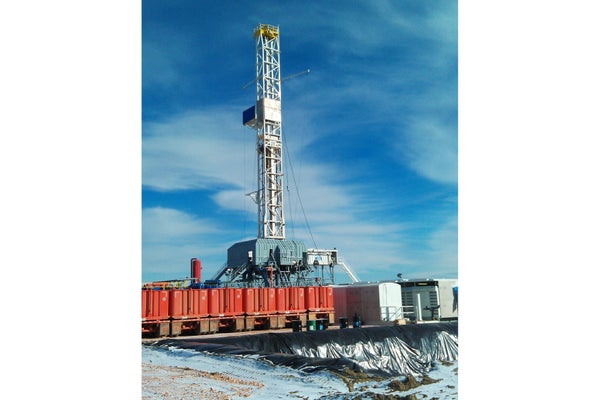

When oil and gas companies extract fuel from the earth via fracking, they routinely add biocides such as glutaraldehyde to the high-pressure water they use to fracture rock formations deep underground. These compounds are a preemptive strike against microbes that produce hydrogen sulfide, which can corrode pipelines.
New research, however, calls into question the across-the-board addition of toxic biocides to water used in fracking. Jason Gaspar and Pedro Alvarez at Rice University and colleagues, including scientists at energy firm Statoil, performed numerous tests at fracking sites in the Bakken Shale Formation in the north-central U.S. and in Canada. There, they found that H2S might be formed in fracking wells by geochemical reactions, rather than microbes (Environ. Sci. Technol. Lett.2016, DOI:10.1021/acs.estlett.6b00075).
At the Bakken sites, the team found, temperatures at the depths that the biocide-laden water is injected run about 120 °C, too hot for sulfogenic microbes to survive. In addition, DNA tests of injected water samples showed no evidence of microbes, and sulfur isotope analysis indicated that H2S recovered from the samples was produced abiotically.
On supporting science journalism
If you're enjoying this article, consider supporting our award-winning journalism by subscribing. By purchasing a subscription you are helping to ensure the future of impactful stories about the discoveries and ideas shaping our world today.
The researchers suggest that the H2S might instead have been produced via the reaction of underground calcium sulfate anhydrite with methane.
H2S problems at other, cooler sites, such as the Marcellus shale formation in the eastern U.S., may still be caused by bacteria.
But, Gaspar says, a well-by-well approach to applying biocides might be more cost-effective. For example, companies could take core samples at each site and share their results in an open-source database.
Thomas Borch of Colorado State University says the discovery that H2S may be produced abiotically is “definitely eye-opening.” However, he’s concerned that the abiotic H2S treatment could involve increased use of corrosion inhibitors.
Radisav Vidic, at the University of Pittsburgh, says the study adds to growing evidence that the blanket use of biocides is unwarranted.
Kyle James Bibby, also at the University of Pittsburgh, agrees. “This work is an important reminder that biocide isn’t the solution to all problems,” he says.
This article is reproduced with permission from Chemical & Engineering News (© American Chemical Society). The article was first published on April 7, 2016.