
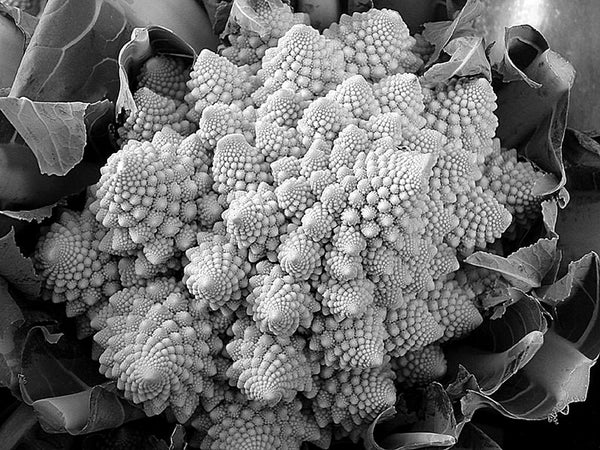
Fractals: On the Edge of Chaos
by Oliver Linton
Bloomsbury, 2021 ($14)
Most of the shapes found in nature cannot be described mathematically using classical geometry. Rather than simple straight lines, cones or circles, natural shapes, such as a coastline or the billows of a cloud, often reveal more angles the closer you view them. Such is the nature of fractals, writes former physics teacher and mathematics enthusiast Linton in this visually absorbing collection. Magnified fractal shapes and their components are often self-similar, meaning the whole has roughly the same shape as its smaller pieces—think of the repeating pattern of branches on a tree or the fronds of a fern. The field of fractal geometry was officially named in 1982, although many mathematicians worked on these concepts earlier. In 1904 Swedish mathematician Helge von Koch described the self-similar patterns of a snowflake, showing that math is truly behind the tiniest natural wonders.
Strange Bedfellows: Adventures in the Science, History, and Surprising Secrets of STDs
by Ina Park
Flatiron Books, 2021 ($27.99)
On supporting science journalism
If you're enjoying this article, consider supporting our award-winning journalism by subscribing. By purchasing a subscription you are helping to ensure the future of impactful stories about the discoveries and ideas shaping our world today.
An epidemic other than COVID-19 has been growing in the U.S.: sexually transmitted infections (STIs). Stigma, writes physician Park, prevents people from discussing them and thus stifles any hope of curbing the current trend. Through intriguing anecdotes, she covers the science behind the treatment and prevention of STIs. She recounts kissing her young son to infect him with common oral herpes, hoping he would build antibodies against genital herpes. And she jokes that Pthirus pubis, the pubic lice commonly referred to as crabs, could be at risk of going extinct because pubic hair grooming has become more popular. The stigma could be defeated, Park writes, if only “the ‘ick’ factor around STIs might gradually be replaced with a bit of wonder and fascination.” —Karen Kwon
Under a White Sky: The Nature of the Future
by Elizabeth Kolbert
Random House, 2021 ($28)
The danger of the term “Anthropocene,” which many scientists have lobbied to use to describe the current geologic period of Earth's history defined by human impact, is that it sounds clinical and detached. It seems to belong in a forgotten dusty geology tome. In reality, writes journalist Kolbert, our species is altering the planet in infinite and messy ways, in some cases irreparably. This intimate natural history is both a sober assessment of the ecosystems we have harmed and an exciting description of some of the discoveries that could help undo that damage. To cure Earth of ourselves, we must use our own ingenuity to devise solutions such as breeding extinction-resistant fish and shooting diamonds into the stratosphere to curb global warming. If we humans write the Anthropocene, let's hope the final story is one of redemption.
The Mission: A True Story
by David W. Brown
Custom House, 2021 ($35)
The Mission is not a paint-by-numbers book about space exploration. Rather than focusing on the technical details of its topic—NASA's multibillion-dollar Europa Clipper mission, currently set to launch in 2025 to search for alien life—the book zooms in on the personalities behind it. Journalist Brown labored (with obvious love) for seven years interviewing a small army of scientists, engineers and bureaucrats, and the result is a magnificent portrait of the people responsible for making scientific dreams come true, via the decades-long process of transforming PowerPoint presentations into real spacecraft awaiting liftoff on a launchpad. This book cannot answer the question of what—if anything—lurks in Europa's dark abyss, but it masterfully reveals with remarkable clarity what lies within the hearts of the men and women determined to find out. —Lee Billings