
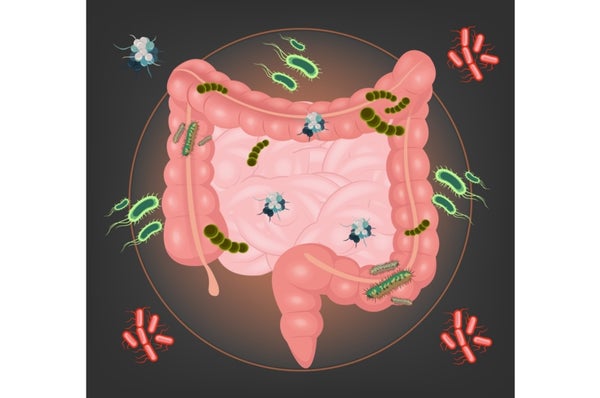
Why do some patients respond well to the new cancer immunotherapies and others don't? The genetic components of the tumors or of the patients may contribute. Our work and that of other scientists now also suggest a role for differences in the makeup of the individuals' microbiome, the friendly bacteria that inhabit various parts of the body.
These bacterial communities, particularly the ones found in the intestines, can differ in their constituent species. Those species, in turn, influence the strength of a host immune system's inflammatory response by mechanisms that are still incompletely understood. Some bacteria prompt an inflammatory overreaction that nudges normal cells into becoming cancerous or mistakenly trains immune cells to attack healthy tissue in the joints, as in rheumatoid arthritis.
Sometimes bacteria might be able to trigger a therapeutic response. Our group, based at the University of Chicago, studied genetically identical strains of mice that had different microbiomes because they were raised in different environments. After the mice were injected with cells from melanoma skin cancer, the resulting tumors grew slowly in one group and faster in the other. The mice that showed slower tumor growth also mounted a stronger immune response against their tumor. Strikingly, transplanting the microbiome from mice with slower-growing tumors into the other mice—we do this by transferring fecal material between the animals—resulted in slower-growing tumors in the latter group.
On supporting science journalism
If you're enjoying this article, consider supporting our award-winning journalism by subscribing. By purchasing a subscription you are helping to ensure the future of impactful stories about the discoveries and ideas shaping our world today.
By analyzing the DNA in stool samples from the two mouse groups, our team found two bacterial species from the genus Bifidobacterium that seemed responsible for improved antitumor activity. Remarkably, feeding the mice just one strain—either Bifidobacterium longum or Bifidobacterium breve—was sufficient to boost the immune system and slow down tumor growth in recipient mice. The presence of these beneficial bacterial strains even determined how well one new immunotherapy drug, a so-called checkpoint inhibitor, worked. The tumors disappeared entirely in mice that were treated with the checkpoint inhibitor and whose microbiome included the Bifidobacterium species; mice lacking Bifidobacterium, however, experienced only a partial response to the drug but were cured if also fed the right bacterial strains.
A second team of researchers—based primarily in France—conducted a similar experiment with a different checkpoint inhibitor. They determined that another bacterial genus, Bacteroides, allowed the treated animals to eliminate injected tumors. Giving the animals an antibiotic that killed these microbes rendered the anticancer drug ineffective—something that should give doctors pause, given how many cancer patients also receive antibiotics. Results from the French and Chicago groups were published in November 2015 in Science.
Obviously we need to categorize the bacteria in the human microbiome and their potential antitumor effects more completely before we can recommend any treatments in people. Whereas bacteria such as Bifidobacterium seem to have favorable effects, other strains might allow tumors to grow more rapidly. (Consuming yogurt to boost immune treatments might not work either. Yogurt typically contains Bifidobacterium lactis or Bifidobacterium bifidum, which may not have the same effects as the species used in the recent mouse studies.) Nor would clinicians want to boost the immune system too much, lest they trigger autoimmune diseases.