
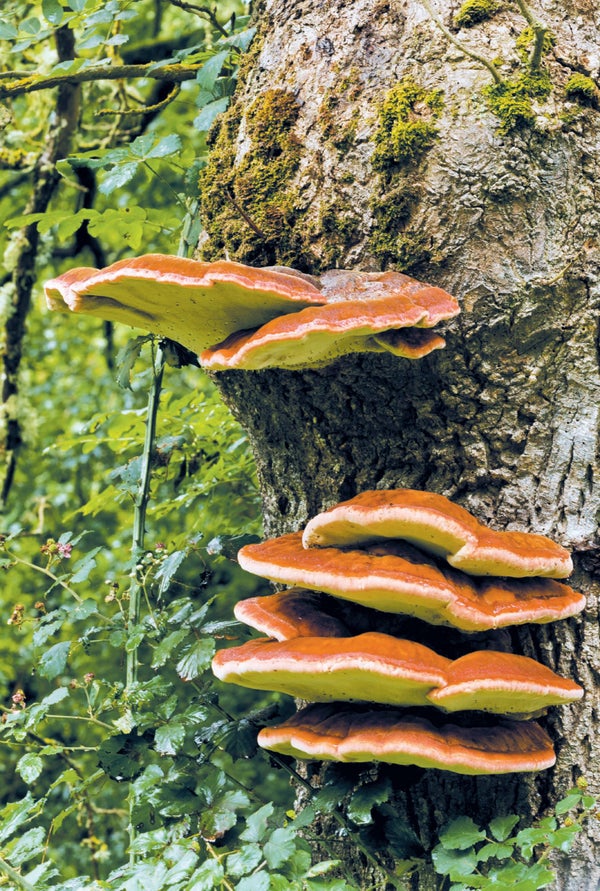
In a world where fire threatens more and more homes, scientists have developed a surprising type of material that might keep some buildings safer: wafer-thin sheets of fungi.
Underneath every mushroom is a sprawling, branching network of rootlike structures called a mycelium. Now researchers have successfully grown these networks into Pop Tart–size sheets that could act as a fire retardant in building materials, according to a new study in Polymer Degradation and Stability.
Using a biological material like mycelium has enormous benefits, says senior author Everson Kandare. Unlike asbestos, which is still sometimes added to building materials as a fire retardant, mycelium does not shed noxious compounds when exposed to fire. “When there is a building fire, it [often] isn't the flame intensity or the heat that kills or injures people,” says Kandare, an engineer at RMIT University in Melbourne, Australia. “It is the fumes and the toxic metal that comes out of building materials.”
On supporting science journalism
If you're enjoying this article, consider supporting our award-winning journalism by subscribing. By purchasing a subscription you are helping to ensure the future of impactful stories about the discoveries and ideas shaping our world today.
The new mycelium sheets, grown into their unique shape in a plastic container and stacked into protective mats up to a few millimeters thick, could prevent such building materials from burning in the first place. Mycelium contains a lot of carbon. When exposed to fire, the sheet briefly burns, releasing water and carbon dioxide into the air, before petering out and leaving behind a black layer of carbon.
“In order for fire to spread, it has to burn. If you're left with an area you can't burn, then that stops the fire,” says Chris Hobbs, a polymer chemist at Sam Houston State University in Texas, who was not involved in the new study but says he considers the material promising.
Scientists have known about mycelium's flame-retardant properties for several years, but Kandare says this study is the first to incorporate these properties into a useful building material. He suggests mycelium could replace the fire-retardant foam that insulates many commercial buildings, which can produce carbon monoxide and other toxic products when it combusts.
The RMIT team has been reaching out to mushroom farmers to see whether they could scale the technology for commercial use. Kandare is optimistic because mycelium can grow in the dark, which means its energy needs are relatively minimal—and the team fed its prototype with ordinary molasses. Even better, mycelium is a biological material, and any waste it leaves behind is compostable.
“If the product reaches the end of its life, you can just chuck that mycelium in your garden,” Kandare says. “Just toss it in the green beans.”