
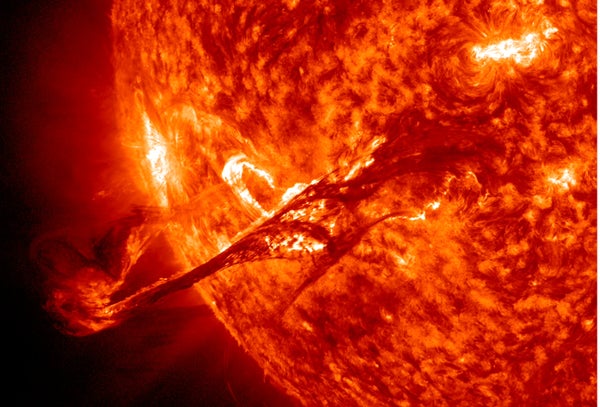
Humanity has begun collectively grappling with the dangers of global threats such as climate change. But few authorities are planning for catastrophic solar storms—gigantic eruptions of mass and energy from the sun that disrupt Earth's magnetic field. In a recent preprint paper, two Harvard University scientists estimate the potential economic damage from such an event will increase in the future and could equal the current U.S. GDP—about $20 trillion—150 years from now.
There are precedents for this kind of storm. The so-called Carrington Event of 1859 began with a bright solar flare and an ejection of magnetized, high-energy particles that produced the most intense magnetic storm ever recorded on Earth. It caused brilliant auroras in the atmosphere and even delivered electric shocks to telegraph operators. But a Carrington-scale storm today would cause far more harm because society now depends so heavily on electrical power grids, communications satellites and GPS.
In an effort to quantify that threat, astrophysicists Abraham Loeb and Manasvi Lingam of the Harvard-Smithsonian Center for Astrophysics developed a mathematical model that assumes society's vulnerability to solar burps will grow in tandem with technological advances. Under this model (described in the paper, which was submitted to arXiv.org), during the next 50 years the potential for economic damage will depend primarily on the rising odds of a strong solar storm over time. Beyond 50 years our vulnerability will increase exponentially with technological progress until the latter levels off.
On supporting science journalism
If you're enjoying this article, consider supporting our award-winning journalism by subscribing. By purchasing a subscription you are helping to ensure the future of impactful stories about the discoveries and ideas shaping our world today.
Some scientists question the model's predictions. “Estimating the economic impact is challenging now, let alone in over a century,” says Edward Oughton, a research associate at the University of Cambridge's Center for Risk Studies. Yet he warns that uncertainty should not deter us from practical preparations, such as making power grids more resilient and improving early-warning systems.
Loeb and Lingam envision a much wilder strategy: a $100-billion magnetic deflector shield, positioned between Earth and the sun. This idea seems “pretty preposterous,” however, given that solar particles arrive at Earth from all directions, says Daniel Baker, director of the Laboratory for Atmospheric and Space Physics at the University of Colorado Boulder.
A better understanding of “space weather”—the changing conditions in Earth's outer space environment, including solar radiation and particles—could help find the best strategies for confronting a dangerous solar storm, says Stacey Worman, a senior analyst at consulting firm Abt Associates. “This is a challenging but important question,” Worman says, “that we need more eyes on.”