
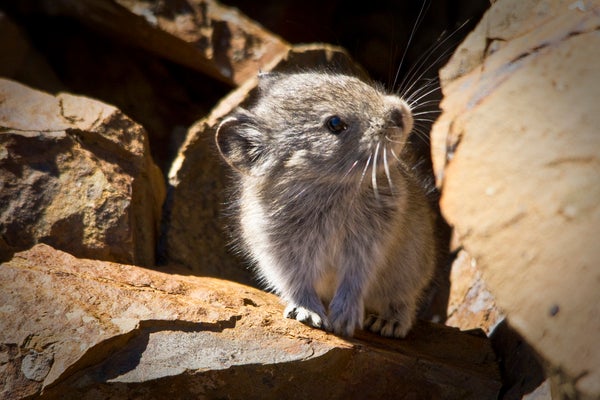
A small, fuzzy creature might help researchers reimagine conservation in the age of rapidly changing environments.
Experts expect climate change to cause more endangered species to go extinct while bringing others to the brink. Most species slowly try to adapt — often by changing the timing of major life events, like reproduction. They can also alter migration and feeding habits.
Sometimes that works. But the same species can show great adaptive potential in some places while dying out elsewhere, according to a paper published this week in Frontiers in Ecology and the Environment.
On supporting science journalism
If you're enjoying this article, consider supporting our award-winning journalism by subscribing. By purchasing a subscription you are helping to ensure the future of impactful stories about the discoveries and ideas shaping our world today.
"For a while, folks were talking about species being climate change winners or climate change losers," said Erik Beever, a researcher with the U.S. Geological Survey and an author of the paper.
Instead, it seems like an elusive mix of factors influence whether a species can survive — or even thrive — in changing landscapes.
That makes it trickier to determine the resilience of a species spread across different areas, Beever said, because it's difficult to untangle the "menagerie" of conditions at play.
A case study in that is the pika.
Pikas resemble chubby hamsters — with round ears, no tail, and small, furry bodies — but they're more closely related to rabbits. They typically live in mountainous areas, isolated from most human contact.
But the researchers documented a population of pikas living at low elevations in Oregon's Columbia River Gorge. They adapted to their environment by using thick moss as insulation from the summer heat, or by using the nearby forest as shade so they could stay active during the day.
But pikas living elsewhere didn't show the same adaptivity.
In more than 23 years of observation, the pikas living in the Great Basin never showed such flexibility in habitat selection, the researchers wrote. That has led to sharp population declines.
The researchers also found differences in foraging habits and body posture as a way to regulate temperature.
There's no easy explanation for why some pikas adapt more than others.
"Is it the physical environment that's allowing this [behavioral] plasticity? Is it their genetic evolution to employ these behaviors?" Beever asked. "How do we disentangle those? I don't know."
It's an unsettling problem, he said, because it means conservationists need to work even harder to understand why some creatures are faring better than others.
But the results also offer hope, he said. Just because a species is struggling to adapt in one region doesn't mean it will fare as badly elsewhere. And paying closer attention to behavioral changes can help conservationists adapt their own management practices.
"The simplest way to put it is: Can a species either cope with or adapt to climate change? The answer is, it depends," he said.
Reprinted from Climatewire with permission from E&E News. E&E provides daily coverage of essential energy and environmental news at www.eenews.net.