
On supporting science journalism
If you're enjoying this article, consider supporting our award-winning journalism by subscribing. By purchasing a subscription you are helping to ensure the future of impactful stories about the discoveries and ideas shaping our world today.
The galaxy cluster Abell 2744 contains so many unusual phenomena that astronomers have dubbed it "Pandora's Cluster," after the mythological box said to contain all the world's ills. Unlike the eponymous box, this object contains phenomena that aren't evil (at least we hope not), and could even reveal some of the mysteries of dark matter. But what makes this cluster so interesting is not apparent to the unaided eye.
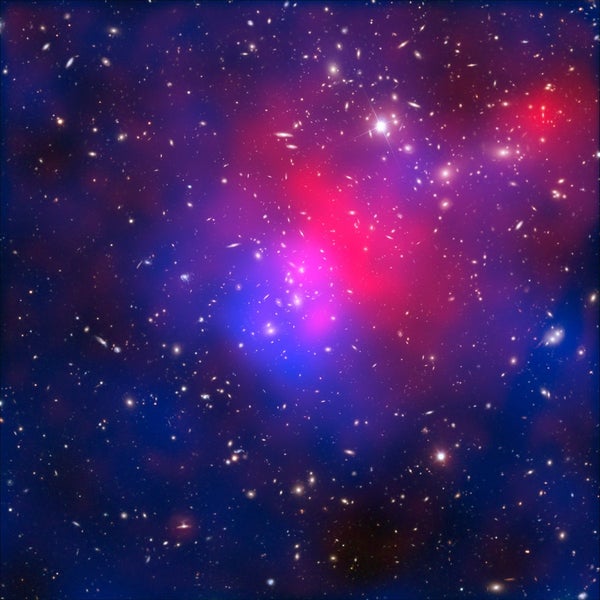
In order to complete this image of Abell 2744, astronomers compiled visible light gathered by NASA's Hubble Space Telescope, the Very Large Telescope at the European Southern Observatory, and Japan's Subaru telescope. Scientists, however, had to use x-ray emissions taken by the orbiting NASA Chandra X-Ray Observatory to reconstruct the location of hot gases (colored red). In order to map invisible dark matter (shown in blue) scientists had to look at how the light from background galaxies was distorted by its gravity, and then reconstruct the dark matter's location mathematically.
This picture of Abell 2744 unveils its history, and its anomalies. Pandora's Cluster probably formed from the collision of four different parent clusters, a process that lasted millions of years. When two of the parent clusters smashed together, their collision created a central "bullet," where the impact of gas on gas created a shock wave in matter but left the distribution of dark matter untouched. In a separate region of Pandora's cluster there is a gas-free cluster of dark matter and galaxies, where the parent clusters' collision stripped away any hot gas. In yet another region a clump of dark matter sits alone, with neither galaxies nor gas.
The segregated arrangement of galaxies, hot gas and dark matter in Abell 2744 is unprecedented. Although certain other galaxy clusters do exhibit bullets or clumps, no other system combines these features. By studying Pandora's Cluster, astronomers hope to glean more information about the behavior of dark matter and its interaction with more familiar materials.
--Sophie Bushwick