
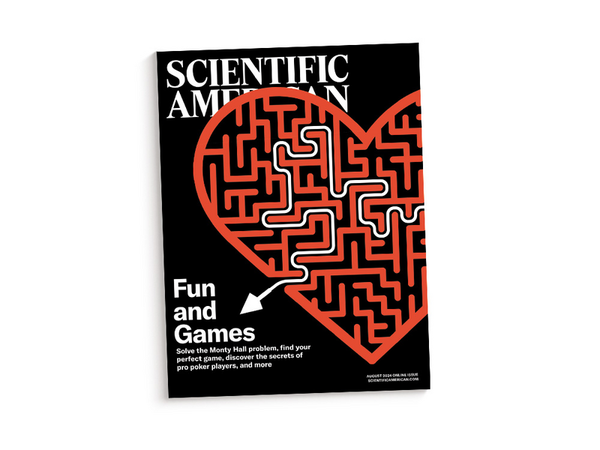
For something that often gets dismissed as trivial, games are a serious part of our lives. Play is evolutionary ancient, and this deeply ingrained behavior helps us understand not just our environment but also the way we relate to one another. Kelly Clancy, a neuroscientist and author, says it goes even deeper than that. “Games are a kind of domestication,” she writes in her essay for our special digital issue, Fun and Games, and throughout history, they have been used to imbue moral lessons and teach people to achieve goals. Today game designers are behind so much of our daily lives, creating hidden rules that run our dating apps, social feeds and financial systems.
Beyond a powerful tool for socialization, games help us understand ourselves. In an essay regarding her experiences in live-action role-play (LARP), Ericka Skirpan writes about how embodying different characters revealed surprising facets of herself. Games that are challenging to figure out can get lodged in our mind—and stay stuck there for years. Scientific American’s associate news editor Allison Parshall takes us on her journey of how she finally got to the bottom of the infamous Monty Hall problem—a uniquely befuddling puzzle popularized by the game show Let’s Make a Deal.
[Play science-inspired games, puzzles and quizzes in our new Games section]
On supporting science journalism
If you're enjoying this article, consider supporting our award-winning journalism by subscribing. By purchasing a subscription you are helping to ensure the future of impactful stories about the discoveries and ideas shaping our world today.
Virtual reality might have brought us stunning, immersive game experiences, but the world’s oldest games are still delightful to play. Writer Stephanie Pappas has collected 10 ancient games—from Go to the Royal Game of Ur—and can teach you how to play them. We also enjoyed digging into the Scientific American archive to bring you articles from the late Martin Gardner's legendary column, “Mathematical Games.”
Advances in technology don’t necessarily make games better, nor do they render computers the undisputed champion over people. Jack Murtagh, Scientific American’s math columnist, dives deep into how artificial intelligence has allowed poker players to find the optimal strategy. You’d think everyone would always use it, but the best players still win by staying flexible and exploiting their opponents’ mistakes. In baseball, the push toward optimization and faster, more exciting play has made pitchers throwing at more than 100 miles per hour a common occurrence. Yet as writer Abe Streep explains, pitchers’ elbows are having a hard time keeping up.
As serious as games can be, they are also just fun. It can be overwhelming to know what to play when there are so many types to choose from. So we made our own interactive game to help you decide! Writer and game lover Diana Kwon has provided options for every style and mood. (I personally fell in love with the manipulation tactics in Codenames. And Wavelength made my friends and I laugh so hard that we literally cried.) Crossword nerds are in for a treat with a custom, science-themed puzzle. And when you’re done reading and playing your way through this special issue, head over to our brand-new Games page, where you’ll find a word game called Spellements, quirky science news and trivia quizzes, plus jigsaw and math puzzles. Come back daily to play something new.