
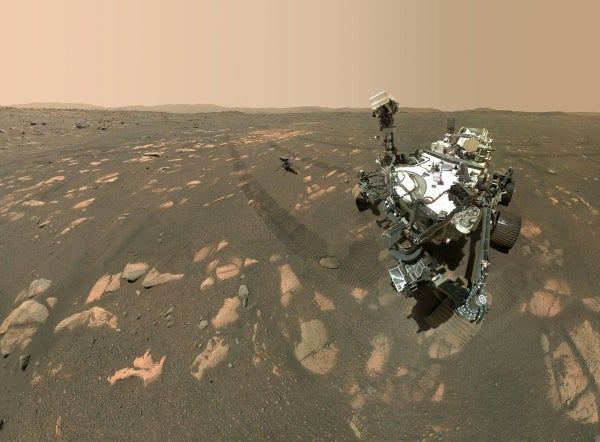
The surface of Mars may be littered with traces of the same minerals that make up rubies, sapphires and opals on Earth—but there are critical differences that mean any potential future mining expedition to the Red Planet would almost certainly be a bust. Instead, experts say, the minerals’ presence and the way that they came to be could offer clues to Mars’s planetary history and the question of whether the world ever hosted life.
A growing body of evidence collected by both NASA’s Mars rovers and satellites orbiting the planet suggest that Mars does hold some quotient of gemstonelike minerals. For example, a paper published in April analyzed observations of stones inside the planet’s Jezero Crater made by NASA’s Perseverance rover’s near-infrared spectrometer. The instrument can identify minerals by analyzing their light signatures. It found that the light-toned stones contained high amounts of corundum, a form of oxidized aluminum. That’s the family of minerals that includes expensive jewels such as rubies and sapphires.
But while the stones on Mars bear a passing resemblance to gems such as rubies on a molecular level, they are not the shimmering red rocks we might find on Earth, says Candice Bedford, a co-author of the study and a research scientist at Purdue University. On our planet, rubies are made in the extreme heat and pressure of Earth’s crust as a result of plate tectonics. But on Mars, the corundum likely formed as a result of an asteroid impact in which aluminum in the asteroid rapidly fused with Martian minerals.
On supporting science journalism
If you're enjoying this article, consider supporting our award-winning journalism by subscribing. By purchasing a subscription you are helping to ensure the future of impactful stories about the discoveries and ideas shaping our world today.
The means the stones on Mars are “not really going to be gem quality, because they’re made within seconds of this intense impact,” Bedford says. She points to diamonds discovered in Siberia’s Popigai impact structure; forged in an asteroid strike, they are quite unlike diamonds created by Earth’s geological forces. They don’t share natural diamonds’ shine and tend to be extremely small—too tiny for use in jewelry. Similarly, the corundum on Mars was found in stones about “the size of pebbles,” Bedford says, while the mineral traces themselves were even smaller—less than a millimeter.
Further evidence gathered by both the Mars Reconnaissance Orbiter, a satellite that probes Mars’s surface for clues to its current and past geology, and NASA’s Perseverance rover suggests the planet also has material made up of crystals of hydrated silica—a mineral better known on Earth as opal. Like the corundum, however, the size of the opals found on Mars appear to be very small, says Vivian Sun, a planetary scientist at NASA’s Jet Propulsion Laboratory.
“I think, definitely, there is the misconception that these are gemstone-quality-type rocks that we’re reporting on Mars,” Sun says. “That is definitely not the case.”
Even if it were, mining Mars for gems would make little economic sense, says Matt Gialich, CEO and co-founder of the asteroid mining firm AstroForge. High-quality rubies and opals are still accessible here on Earth, making the expense of developing and launching a Martian mining operation pointless from that perspective.
Still, like the rubies, the opals hold incredible scientific value, offering clues to whether Mars was ever home to life. The structure of opal crystals makes them well-suited to preserving biosignatures of tiny life-forms such as bacteria. But finding those potential biosignatures would require bringing a sample back to Earth to examine with an electron microscope.
That seems increasingly unlikely to happen anytime soon. Last November the Trump administration shelved a planned mission to return soil samples from Mars, despite years of planning and millions of dollars that were already spent toward that goal.
That’s a tragedy, Sun says. The geology of Mars could offer tremendous insight into the earliest days of our solar system. Mars’s plate tectonic system is far simpler than Earth’s, meaning there are rocks on the Red Planet that are much older than what can easily be found on our own world. A close examination of what they contain has the potential to answer questions about Earth such as “What did the early planet look like?” Sun says. “How did Mars form? How did any of the terrestrial planets form? You really have to look at those old rocks, and you have to look at the primary minerals from those rocks.”