
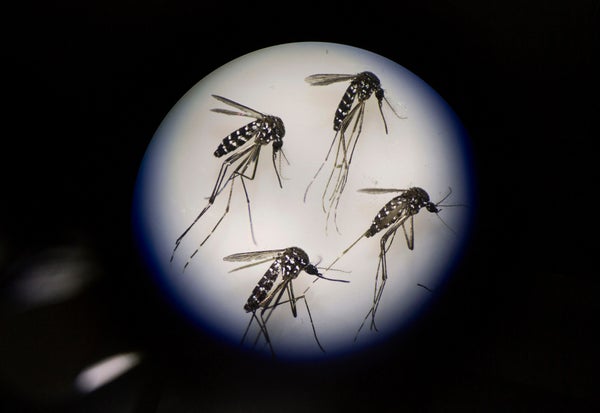
In the small city of Terni in central Italy, researchers are putting the final touches on what could be the world’s most sophisticated mosquito cages. The enclosures, each occupying 150 cubic metres, simulate the muggy habitats in which Africa’s Anopheles gambiae mosquitoes thrive. By studying the insects under more-natural conditions, scientists hope to better understand how to eradicate them—and malaria—using an emerging genetic-engineering technology called gene drives.
The technique can quickly disseminate genetic modifications in wild populations through an organism’s offspring, prompting some activists to call for it to be shelved. Yet gene drives might not be as effective as activists think. Recent research has identified a major hurdle to using them to eliminate diseases and vanquish invasive pests: evolution.
Organisms altered by gene drives, including mosquitoes, have shown promise in proof-of-concept laboratory experiments. But wild populations will almost certainly develop resistance to the modifications. Researchers have begun identifying how this occurs so that they can address the problem.
On supporting science journalism
If you're enjoying this article, consider supporting our award-winning journalism by subscribing. By purchasing a subscription you are helping to ensure the future of impactful stories about the discoveries and ideas shaping our world today.
Gene drives thwart the rules of inheritance in sexually reproducing organisms. Normally, offspring have a 50:50 chance of inheriting a gene from their parents. Gene drives alter those odds, preferentially passing on one version to an organism’s offspring until, in theory, an entire population bears that gene.
Such ‘selfish’ genetic elements occur naturally in mice, beetles and many other organisms, and researchers have had modest success with hijacking them to battle pests. But interest in gene drives has surged with the advent of CRISPR–Cas9 gene editing, which can be used to copy a mutation from one chromosome into another.
In late 2015, researchers reported a CRISPR gene drive that caused an infertility mutation in female mosquitoes to be passed on to all their offspring. Lab experiments showed that the mutation increased in frequency as expected over several generations, but resistance to the gene drive also emerged, preventing some mosquitoes from inheriting the modified genome.
This is hardly surprising, says Philipp Messer, a population geneticist at Cornell University in Ithaca, New York. Just as antibiotics enable the rise of drug-resistant bacteria, population-suppressing gene drives create the ideal conditions for resistant organisms to flourish.
One source of this resistance is the CRISPR system itself, which uses an enzyme to cut a specific DNA sequence and insert whatever genetic code a researcher wants. Occasionally, however, cells sew the incision back together after adding or deleting random DNA letters. This can result in a sequence that the CRISPR gene-drive system no longer recognizes, halting the spread of the modified code.
The researchers building the mosquito cage in Italy, part of a multimillion-dollar project called Target Malaria, found this form of resistance in some mosquitoes. And Messer’s team reported in December that these mutants are likely to flourish.
Natural genetic variation is another route to resistance. CRISPR-based gene drives work by recognizing short genetic sequences, and individuals with differences at these sites would be immune to the drive. A recent study analysed the genomes of 765 wild Anophelesmosquitoes from across Africa. The team found extreme genetic diversity, which would limit the list of potential gene-drive targets, the researchers say.
“These things are not going to get too far in terms of eradicating a population,” says Michael Wade, an evolutionary geneticist at Indiana University Bloomington. Gene drives could result in the genetic isolation—in which populations do not mate with each other—of groups that manage to avoid inheriting the modified genetic code, he and his colleagues found. And gene variants that decrease a population’s propensity to mingle with other populations—such as those that limit flight capacity in insects—would suddenly prove beneficial and could spread.
Resistance to gene drives is unavoidable, so researchers are hoping that they can blunt the effects long enough to spread a desired mutation throughout a population. Some have floated the idea of creating gene drives that target multiple genes, or several sites within the same gene, diminishing the speed with which resistance would develop. By surveying a species’ natural genetic diversity, researchers could target genes common to all individuals.
The Target Malaria team has developed a second generation of gene-drive mosquitoes, hoping to slow the development of resistance, says Andrea Crisanti, a molecular parasitologist at Imperial College London. The researchers plan to test them in their new Italian facility later this year to get a sense of how the mosquitoes might fare in the wild. But molecular biologist Tony Nolan, also at Imperial, expects evolution to throw up some surprises. He says that his greatest worry about gene drives is that they simply won’t work.
This article is reproduced with permission and was first published on January 31, 2017.