
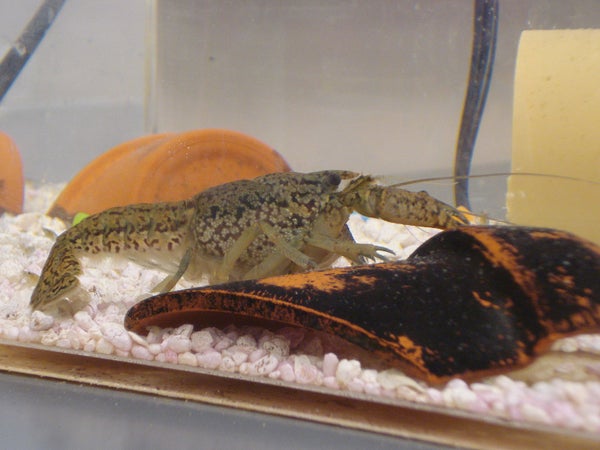

Molecular biologists have sequenced the genome of an invasive species of crayfish that can reproduce without mating and is spreading rapidly across Madagascar. The marbled crayfish (Procambarus virginalis) was first spotted in aquariums in Germany in the 1990s. Now, DNA sequencing suggests that the species is probably the product of two distantly related members of a different crayfish species, a team reported on February 5 in Nature Ecology and Evolution.
The marbled crayfish has already been banned in the European Union and some parts of the United States because of the threat it poses to freshwater ecosystems. The species has now spread into the interior of Madagascar and risks crowding out seven native crayfish species. “This is a very aggressive population,” says Frank Lyko, a molecular biologist at the German Cancer Research Center in Heidelberg, who co-led the study. “If the marble crayfish continues to explode at its current pace, it will probably outcompete endemic species.”
The marbled crayfish carries three copies of each chromosome, instead of the usual two. Lyko and his team sequenced the genome of a single individual from a laboratory strain known as Petshop. Its DNA revealed a surprise: it had two different genotypes at many places of its genome. The best explanation for this pattern, says Lyko, is that two of the chromosomes are nearly identical in sequence, but the third differs substantially.
On supporting science journalism
If you're enjoying this article, consider supporting our award-winning journalism by subscribing. By purchasing a subscription you are helping to ensure the future of impactful stories about the discoveries and ideas shaping our world today.
The two distinct genomes are closely related to those of another freshwater crayfish, Procambarus fallax, native to Florida and popular with aquarists. Lyko speculates that marbled crayfish emerged when the genome of a sperm or egg of one P. fallax individual became duplicated, which can happen in response to sudden changes in temperature. If these cells were then fertilized by another individual living in the same aquarium, it would result in an embryo with three copies of its genome, says Lyko. This would represent a new species. Lyko says that the first marbled crayfish was probably born in an aquarium in either Germany or the United States, and that its offspring were widely shared between fish collectors.
Origins of a species
The first scientific description of the marbled crayfish appeared in 2003, in a Nature paper showing that all members of the species they surveyed are female and reproduce through parthenogenesis—a process by which an unfertilized egg develops into an adult with a genome identical to its mother’s.
How the first marbled crayfish gained the ability to reproduce through parthenogenesis is a mystery, says Lyko. Loss or mutation of sexual-reproduction genes could underlie the transition.
Lyko’s theory is reasonable, says Gerhard Scholtz, a zoologist at Humboldt University of Berlin who led the first study of marbled crayfish. He wonders why there were two different populations of P. fallax in the same tank. The species might even have emerged in the wild. “The fact that natural marbled-crayfish populations have not been found in the wild does not mean that they do not exist,” he says.
To better understand the species’ spread, Lyko’s team sequenced the genomes of four other marbled crayfish, including from populations that have escaped from aquariums and colonized German lakes, and an individual from a market in Madagascar. The team did more-limited DNA sequencing of 49 individuals caught across the island. These studies showed a stunning lack of genetic diversity, owing presumably to the species’ recent origin and ability to reproduce through parthenogenesis.
Julia Jones, a conservation scientist at Bangor University, UK, who first identified marbled crayfish in Madagascar in 2007, says that the species’ spread is due largely to their popularity as a food source. In 2009, she met a man on a bus carrying a plastic bag full of them that he planned to dump into his rice fields in the hope of creating a sustainable stock, she says.
Stopping their spread in Madagascar will be “almost impossible”, says Lyko. Collaborators there have begun campaigns urging people not to transport them or release them into rice fields. The message is a hard sell in a country where poverty levels are high and marbled crayfish are a cheap and popular source of protein. Lyko’s colleague brought a few dozen that she had caught to a family barbecue. “This went down quite well,” he says.
This article is reproduced with permission and was first published on February 6, 2018.