
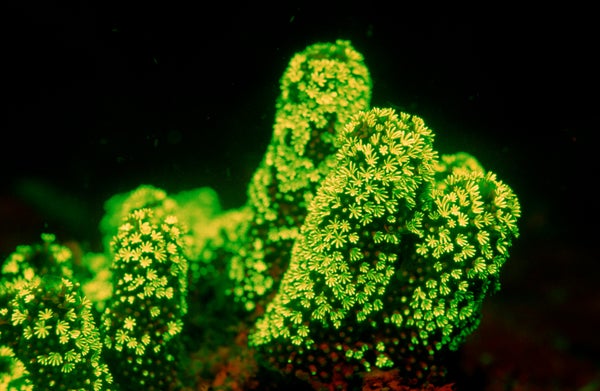
Researchers have pinpointed the reason that deep-water corals emit an erie glow. Scientists know that in shallow waters, the organisms light up green, using fluorescent proteins as kind of sun block. The proteins soak up harmful ultraviolet rays, re-emit green light and shield their symbiotic algae, which supply most of the corals’ energy needs through photosynthesis.
In 2015, a team led by Jörg Wiedenmann at the University of Southampton, UK, found that deep-dwelling corals also fluoresce—this time in an array of vivid yellows, oranges and reds. Some of these organisms live in water as deep as 165 metres, where little sunlight reaches them, and most of what does is in the blue part of the spectrum. So the researchers suspected a different reason for the glow.
Now, Wiedenmann thinks his team has the answer: the corals use a fluorescent protein to optimize the small amount of light available in their habitats for photosynthesis. In other words, the deep-water corals and their shallow relatives fluoresce for opposite reasons.
On supporting science journalism
If you're enjoying this article, consider supporting our award-winning journalism by subscribing. By purchasing a subscription you are helping to ensure the future of impactful stories about the discoveries and ideas shaping our world today.
Blue light is more useful for photosynthesis, but red light penetrates farther into coral tissues. So corals use a red fluorescent protein to convert the blue light into orange–red wavelengths. That means it reaches more of the organisms’ symbiotic algae, helping the corals to survive by making as much food as possible through photosynthesis.
The researchers’ work is published in Proceedings of the Royal Society B and will feature in the Royal Society’s Summer Science Exhibition, which runs until July 9.
“Corals need special features to adjust to life in these low-light depths for the benefit of their vital photosynthetic partners,” says Wiedenmann. The finding “shows how sophisticated the symbiosis between corals and their algal partners can be”.
As researchers worry about the fate of the world’s corals after a spate of bleaching events caused by rising water temperatures, some marine scientists have suggested that stressed shallow-water corals could adapt and find refuge in deeper waters.
However, says Wiedenmann, the study shows that the protein pigments expressed by shallow corals are “biochemically and optically distinct” from those of their deep-dwelling counterparts. “Not many of them may have the capacity to escape to deeper waters,” he says. “We need to make sure that reefs in shallow water stay habitable for corals.”
This article is reproduced with permission and was first published on July 5, 2017.