
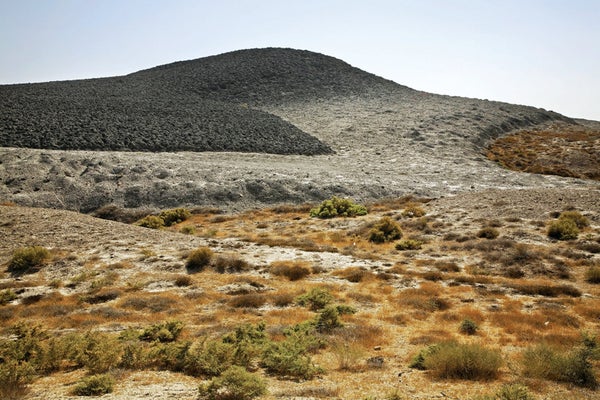
Not all volcanoes belch lava. Some erupt mud—lots of it. Most mud volcanoes just gurgle up bits of muck from time to time, but one is particularly known for frequent, powerful explosions. New research explains what powers these intense eruptions and just how strong they can get.
University of Oslo mud volcanologist Adriano Mazzini and his colleagues studied Lokbatan, a mud volcano in Azerbaijan. Mazzini calls this small country just north of Iran “the kingdom of mud volcanoes.” It has hundreds, but Lokbatan is exceptional.
The volcano's first recorded eruption occurred in 1829. Roughly every five years since then it has launched plumes of mud, sometimes higher than 100 meters. Oil and methane deposits near Lokbatan tend to self-ignite during eruptions, so flames and smoke often accompany the skyrocketing mud. The sight rivals that of a traditional magma-fed volcano, Mazzini says: “They can be equally spectacular and powerful.”
On supporting science journalism
If you're enjoying this article, consider supporting our award-winning journalism by subscribing. By purchasing a subscription you are helping to ensure the future of impactful stories about the discoveries and ideas shaping our world today.
To investigate Lokbatan's impressive eruptions, Mazzini and his colleagues placed 30 gas monitors on the volcano's flanks to sniff for escaping methane and carbon dioxide. The team hypothesized that gases were building up more quickly underneath Lokbatan than under other mud volcanoes, which continuously vent gas into the atmosphere.
Lokbatan “degasses” at less than one-hundredth the rate of another nearby mud volcano, the researchers found. So when it does erupt, they concluded, gas escapes violently, and mud then falls back into the volcano's vent and effectively seals it. The mud “collapses back in and compacts, forming a plug,” Mazzini says, which traps gas that accumulates until it triggers the next explosive eruption.
The researchers also found that Lokbatan's eruptions have likely been violent enough to rip apart its crater rim. They observed three enormous chunks of sediment—the largest topping 300 train cars in volume—to the west of Lokbatan, where portions of the main crater rim are conspicuously missing. These “mega blocks” are probably pieces of crater that broke off in an eruption; the researchers used computer models to show the massive fragments could have surfed kilometers downhill atop a thick layer of flowing mud. Historical records suggest this probably happened during an 1887 eruption, according to the team's study results, detailed in Earth and Planetary Science Letters.
Understanding mud volcano dynamics can inform ideas about what happens on other planets, including Mars, says astrobiologist Shirin Haque of the University of the West Indies at St. Augustine, Trinidad and Tobago, who was not involved in the research. The Red Planet has several possible mud volcanoes, she says, and “mudflows could have affected the present-day landscape we see on Mars.”