
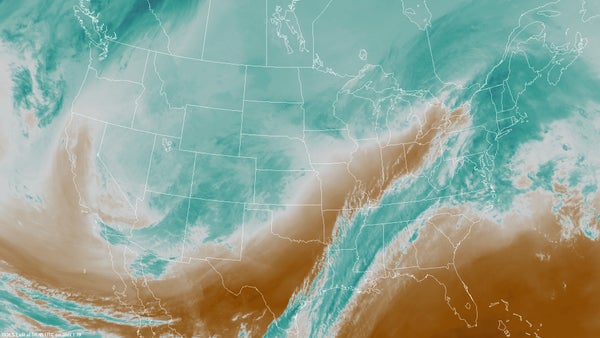
The U.S. government has begun auctioning off blocks of wireless radio frequencies to be used for the next-generation communications network known as 5G. But some of these frequencies lie close to those that satellites use for crucial Earth observations—and meteorologists are worried that 5G transmissions could interfere with their data collection.
Unless regulators or telecommunications companies take steps to reduce the risk of interference, Earth-observing satellites flying over areas of the United States with 5G wireless coverage won’t be able to detect concentrations of water vapour in the atmosphere accurately. Meteorologists in the United States and other countries rely on those data to feed into their models; without that information, weather forecasts worldwide are likely to suffer.
“This is a global problem,” says Jordan Gerth, a meteorologist at the University of Wisconsin–Madison.
On supporting science journalism
If you're enjoying this article, consider supporting our award-winning journalism by subscribing. By purchasing a subscription you are helping to ensure the future of impactful stories about the discoveries and ideas shaping our world today.
The U.S. National Oceanic and Atmospheric Administration (NOAA) and NASA are currently locked in a high-stakes negotiation with the Federal Communications Commission (FCC), which oversees U.S. wireless networks. NOAA and NASA have asked the FCC to work with them to protect frequencies used for Earth observations from interference as 5G rolls out. But the FCC auctioned off the first chunk of the 5G spectrum with minimal protection. The sale ended on 17 April and reaped nearly U.S. $2 billion.
Sharing the sky
Because the United States is such a large communications market, the decisions the government makes about how to deploy 5G are likely to influence global discussions on how to regulate the technology. Regulators from around the world will gather starting on 28 October in Sharm el-Sheikh, Egypt, to hammer out international agreements for which frequencies companies will be able to use for 5G transmissions, and what level of interference with Earth-observation frequencies is acceptable.
Astronomers, meteorologists and other scientists have long worked to share the spectrum with other users, sometimes shifting to different frequencies to prevent conflicts. But “this is the first time we’ve seen a threat to what I’d call the crown jewels of our frequencies—the ones that we absolutely must defend come what may”, says Stephen English, a meteorologist at the European Centre for Medium-Range Weather Forecasts in Reading, UK.
They include the 23.8-gigahertz frequency, at which water vapour in the atmosphere emits a faint signal. Satellites, such as the European MetOp probes, monitor energy radiating from Earth at this frequency to assess humidity in the atmosphere below—measurements that can be taken during the day or at night, even if clouds are present. Forecasters feed these data into models to predict how storms and other weather systems will develop in the coming hours and days.
But a 5G station transmitting at nearly the same frequency will produce a signal that looks much like that of water vapour. “We wouldn’t know that that signal is not completely natural,” says Gerth. Forecasts would become less accurate if meteorologists incorporated those bad data into their models.
Noisy neighbours
The recent FCC auction involved 2 groups of frequencies: one between 24.25 and 24.45 gigahertz and the other between 24.75 and 25.25 gigahertz. Wireless equipment transmitting near the lower end of that range could interfere with the 23.8-gigahertz water-vapour measurement. The FCC did not respond to Nature's request for comment on the matter.
The situation is akin to having a noisy neighbour next door, Gerth says. If that person blasts music, a lot of the noise will probably bleed through the wall into your apartment. But if you can persuade the person to turn their music down, you’ll be able to sleep more peacefully.
Radio-frequency engineers measure noise in units of decibel watts. Regulators set controls that limit the noise allowed; more-negative numbers indicate increasingly stringent controls. The FCC auction set a noise limit on the US 5G network of –20 decibel watts, which is much noisier than the thresholds under consideration by almost every other nation for their systems. The European Commission, for instance, has settled on –42 decibel watts for 5G base stations, and the World Meteorological Organization (WMO) is recommending –55 decibel watts.
Many hope that the WMO numbers will influence regulators to adopt strict global noise standards at the meeting in Egypt. Because of how the scale is devised, the U.S. proposal would allow over 150 times more noise than the European proposal—and more than 3,000 times more than the WMO plan, says Eric Allaix, a meteorologist at Météo-France in Toulouse who heads a WMO steering group on radio-frequency coordination.
Future fears
There’s relatively little research on exactly how bad weather forecasts could get as interference increases at 23.8 gigahertz and other frequencies crucial for Earth observations, says Gerth. “But the more we lose, the greater the impact will be,” he says.
NOAA and NASA have reportedly finished a study on the effects of differing levels of noise interference, but it has not been made public, despite at least one formal request from Congress. A 2010 report from the National Academies of Sciences, Engineering and Medicine concluded that losing scientific access to the 23.8-gigahertz signal would eliminate 30% of all useful data in microwave frequencies, which contribute significantly to global weather forecasts.
And not having atmospheric data from the United States can dramatically hurt forecasts for Europe, whose weather patterns are often steered by conditions over the United States 3–4 days earlier, says English.
The Department of Commerce, which oversees NOAA, said that it "strongly supports the administration's policy to promote U.S. leadership in secure 5G networks, while at the same time sustaining and improving critical government and scientific missions." NASA administrator Jim Bridenstine declined to comment, but spoke at length about his concerns over 5G at an agency meeting earlier this month. "This is a big deal," Bridenstine said.
The FCC plans to begin its next 5G auction, which will be the country’s largest ever, in December. It will involve three more frequency bands—some of which are used for satellite observations of precipitation, sea ice and clouds.
This article is reproduced with permission and was first published on April 26, 2019.
