
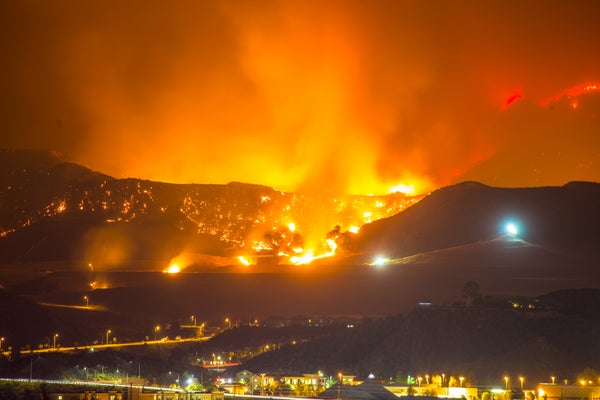
SAN FRANCISCO — Deadly heat waves, Alaskan wildfires and sunny day tidal flooding are some of the events that scientists are increasingly linking to human-caused global warming.
Climate change made 2015 the hottest year on record, and it contributed to the severity of heat waves in India, Pakistan, Europe, East Africa, East Asia and Australia, according to the research of 118 scientists from 18 countries released yesterday by the National Oceanic and Atmospheric Administration.
Scientists looked at 30 weather events in 2015 and found that the vast majority, two dozen, could be linked by some degree to human activities.
On supporting science journalism
If you're enjoying this article, consider supporting our award-winning journalism by subscribing. By purchasing a subscription you are helping to ensure the future of impactful stories about the discoveries and ideas shaping our world today.
“There is a mounting body of evidence that climate change is making heat waves more extreme,” said Stephanie Herring, a scientist with NOAA’s National Centers for Environmental Information.
“The overwhelming scientific consensus is, first of all, extreme events are influenced by climate change today and, second of all, the clearest and strongest scientific evidence is that it has an influence in particular on heat events,” she said.
The report shows that some of the effects of global warming are already occurring and may have been for decades. In 2015 alone, scientists have linked human-caused global warming to Alaskan wildfires, extreme drought in southwestern Canada and even record sunshine in England. The global average temperature hit a record high in 2015 and is expected to do so again in 2016. Global warming also fueled the record strength of cyclones in the Pacific Ocean, placing vulnerable people at risk in some of the world’s poorest places, she said.
“The science clearly shows heat waves are becoming more common,” said Martin Hoerling, a researcher at NOAA’s Earth Systems Research Laboratory.
In a new report, NOAA researchers studied the heat waves, droughts, fires, cyclones and other extreme weather events that occurred throughout the world in 2015 to get a better understanding of what role climate change played.
“It’s becoming more evident even to almost the untrained eye that we are living in the hottest summers, and this is especially true and mirrored more so in the central part of the U.S. for reasons we don’t entirely understand,” he said. “In some parts of the world, heat waves are becoming increasingly common.”
One of the more observable weather events caused by climate change today is the “sunny day” flooding Florida is experiencing as sea levels rise. Miami has seen hundreds of such flooding events as the sea inundates areas that were built to withstand past high tides.
About two-thirds of the more than 100 events studied by scientists over five years have connections to human-caused climate change. For those where no connection has been found, it could be because there was no link or because scientists don’t have the tools to measure it, researchers said.
One weather phenomenon that scientists did not link to climate change is the cold snap in the northeastern United States and Canada in early 2015. It became known as the polar vortex. Scientists also could not link heavy downpours in Nigeria and India to climate change.
The research capability for studying humanity’s effect on the climate has significantly increased in recent years, scientists said. It has grown tremendously in the last 15 to 20 years. That has allowed science to look at events such as heat waves and droughts that occurred decades ago to see whether humans influenced them.
The annual report and improving ability of scientists to identify climate change influence in today’s weather show that “once seemingly impossible insights about climate impacts are now within the capability of timely, rigorous science,” said Jeff Rosenfeld, editor of the Bulletin of the American Meteorological Society, which conducted independent peer reviews of the studies included in the special report.
Scientists are still trying to determine how long humans have been affecting the climate, Herring said. She said observable changes may have been happening for decades or more, but the tools did not exist to measure the weather events for human causation.
“We don’t actually go back and look at history all that often, so we don’t really know when human-caused climate change started to actually impact this world we live in,” she said.
Reprinted from ClimateWire with permission from E&E News. E&E provides daily coverage of essential energy and environmental news at www.eenews.net.