
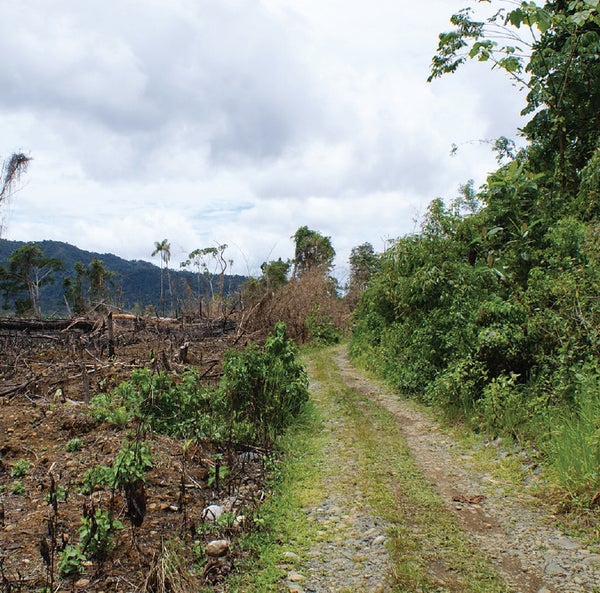
Conservationists who work to save rain forests typically focus on pristine stands—the dwindling number of patches where the buzz of chainsaws has yet to echo. But even clear-cut land may warrant protection. Mounting evidence shows that, under the right circumstances, heavily logged tracts can regrow to host nearly as much biodiversity as unspoiled Amazonian wilderness.
A study published in March in Tropical Conservation Science offers the latest look at the biological value of so-called secondary forests. An international team of ecologists and volunteers spent a year and a half identifying every bird, amphibian, reptile and medium-to-large mammal they could find on some 800 recovering hectares within Peru’s Manu Biosphere Reserve, a UNESCO World Heritage site. Their final count of 570 species amounted to 87 percent of those known to exist in neighboring old-growth, or primary, forests and included many imperiled creatures, such as shorteared dogs and giant armadillos. The team even found what could be new frog species.
The Manu study area represents a “best-case scenario” for secondary forest biodiversity, says Andrew Whitworth of the University of Glasgow in Scotland, who conducted the study in partnership with the Peruvian nonprofit Crees Foundation. Success is more likely at Manu because a longtime hunting and logging ban is in place, and animals can easily wander in from the extensive old-growth zones nearby.
On supporting science journalism
If you're enjoying this article, consider supporting our award-winning journalism by subscribing. By purchasing a subscription you are helping to ensure the future of impactful stories about the discoveries and ideas shaping our world today.

SOURCE: “HOW MUCH POTENTIAL BIODIVERSITY AND CONSERVATION VALUE CAN A REGENERATING RAINFOREST PROVIDE? A ‘BEST-CASE SCENARIO’ APPROACH FROM THE PERUVIAN AMAZON,” BY ANDREW WHITWORTH ET AL., IN TROPICAL CONSERVATION SCIENCE, VOL. 9, NO. 1; MARCH 2016
Graphic by Amanda Montañez
Nevertheless, even lesser quality sites in the beginning stages of renewal provide myriad environmental benefits, including watershed preservation and wildlife corridors. Secondary-growth forests also reduce carbon dioxide pollution: in February researchers reported that regenerating tropical forests pull about 11 times more carbon from the atmosphere than old-growth swaths (which have already approached the maximum amount of carbon they can sequester).
“We’re not saying at any point that this is more important than primary forest,” Whitworth says. “But with good protection and time to regenerate, secondary forests could become very valuable again.” Robin Chazdon, an ecology professor at the University of Connecticut, and her colleagues agree, quipping in a paper that regenerating forests are “like a good Bordeaux,” in that their worth appreciates with each passing year.
For now cleared lands in the tropics usually are converted into palm oil plantations or other agricultural sites without any attempt to assess the potential for reforestation (western Amazon, top). People are beginning to pay attention, however. At a 2014 United Nations climate summit in New York City, several dozen of the world’s largest governments, multinational companies, nonprofits and indigenous groups pledged to restore 350 million hectares of degraded forest by 2030.
“We can’t stop [at] protecting old growth,” says Chazdon, who is advising Brazil on how to revitalize its decimated Atlantic Forest. “That’s not going to be enough.”
