
The world's first telephone call—“Mr. Watson, come here, I want to see you”—was a request for a face-to-face meeting.
I live in Boston, where Alexander Graham Bell made that historic call in 1876, and on a recent trip I passed through Brantford, Ontario, where Bell first dreamed up his telephone in 1874. In Brantford, which bills itself as the “Telephone City,” there's a giant memorial to Bell that includes a bronze casting with figures meant to represent Knowledge, Joy and Sorrow—the varieties of information spread by the telephone.
Today maybe we should reserve a bit of sorrow for the weakening of the personal connections fostered by Bell's miraculous invention.
On supporting science journalism
If you're enjoying this article, consider supporting our award-winning journalism by subscribing. By purchasing a subscription you are helping to ensure the future of impactful stories about the discoveries and ideas shaping our world today.
We own more “phones” than ever, but we don't use them primarily for voice calls. In 2010 Americans spent 2.24 trillion minutes talking on their mobile devices—which averages out to 7,813 minutes per mobile line. By 2017 that had dropped to just 5,539 minutes per line, or 6,686 minutes per U.S. resident.
That's still 18 minutes per person per day, but it's a small slice of the five hours a day we spend doing other things on our mobile devices: watching YouTube and TikTok, browsing Facebook and Twitter, sending text messages, and all the rest. So at the inquest over the falloff in voice communication, Exhibit A is digital data. We consumed 28.6 trillion megabytes of data on our phones in 2018, a dramatic 82 percent increase over 2017 levels, according to the wireless industry group CTIA.
Exhibit B is robocalls. YouMail, which makes a robocall-blocking app, says that 4.7 billion calls were placed to U.S. phone numbers in July 2019 alone, an average of 14 per person. My own phone log shows that I got 36 spam calls that month—so many that I've started ignoring all unscheduled or unidentified calls.
In July the U.S. House of Representatives voted 429–3 to approve a bill that would allow carriers to block suspected robocallers and require them to implement authentication technology to screen out calls from spoofed numbers. The Senate had already passed a similar bill, and the White House is expected to approve a joint version this fall. Representative Frank Pallone, Jr., of New Jersey, chair of the Energy and Commerce Committee, predicted the measure will “restore Americans' confidence in the telephone system.”
But the truth is, it's too late for that. An entire generation of Americans has grown up using phones as glorified pagers. Many people in this group would rather not receive calls at all; speaking on the phone “demands their full attention when they don't want to give it,” as Sherry Turkle observed in Alone Together, her incisive 2011 book about the social price of the mobile revolution.
And to make a call is often seen as tantamount to aggression—a point that's satirized in a recent episode of Netflix's Tales of the City. Sixtysomething Brian is about to call a potential blind date when his fortysomething neighbor Wren grabs his phone out of his hand. “What the hell are you doing?” she exclaims. “I said reach out! That's text! I mean, this is the 21st century. Who's calling someone, you damn psychopath?”
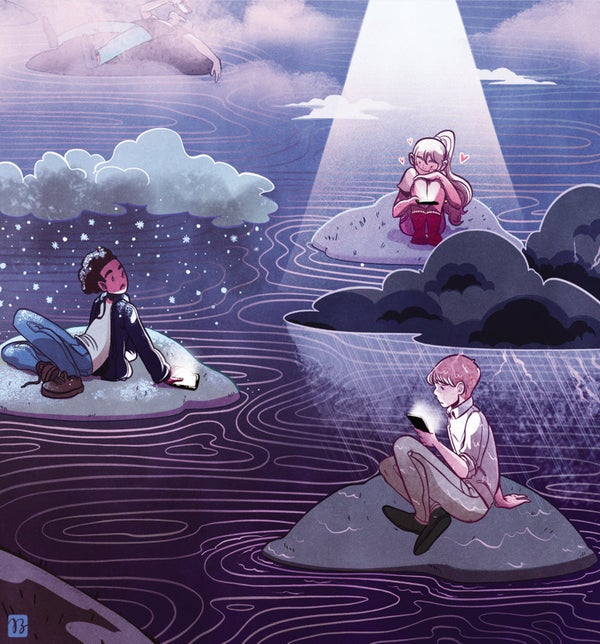
But what's lost when texts and posts replace conversation is, briefly put, Joy and Sorrow: the emotional content conveyed by the human voice. Stripped of this real-time engagement, we're left only with Knowledge, which, as the past few years have shown, is so easily warped and misrepresented. Our telephones may have evolved into machines for 24/7 tweeting and texting, but we're more alone than ever.