

About 115 people nationwide die every day from opioid overdoses, according to the U.S. Centers for Disease Control and Prevention. A lack of timely, granular data exacerbates the crisis; one study showed opioid deaths were undercounted by as many as 70,000 between 1999 and 2015, making it difficult for governments to respond. But now Internet searches have emerged as a data source to predict overdose clusters in cities or even specific neighborhoods—information that could aid local interventions that save lives.
The working hypothesis was that some people searching for information on heroin and other opioids might overdose in the near future. To test this, a researcher at the University of California Institute for Prediction Technology (UCIPT) and his colleagues developed several statistical models to forecast overdoses based on opioid-related keywords, metropolitan income inequality and total number of emergency room visits. They discovered regional differences (graphic) in where and how people searched for such information and found that more overdoses were associated with a greater number of searches per keyword. The best-fitting model, the researchers say, explained about 72 percent of the relation between the most popular search terms and heroin-related E.R. visits. The authors say their study, published in the September 2018 issue of Drug and Alcohol Dependence, is the first report of using Google searches in this way.
To develop their models, the investigators obtained search data for 12 prescription and nonprescription opioids between 2005 and 2011 in nine U.S. metropolitan areas. They compared these with Substance Abuse and Mental Health Services Administration records of heroin-related E.R. admissions during the same period. The models can be modified to predict overdoses of other opioids or narrow searches to specific zip codes, says lead study author Sean D. Young, a behavioral psychologist and UCIPT executive director. That could provide early warnings of overdose clusters and help to decide where to distribute the overdose reversal medication Naloxone.
On supporting science journalism
If you're enjoying this article, consider supporting our award-winning journalism by subscribing. By purchasing a subscription you are helping to ensure the future of impactful stories about the discoveries and ideas shaping our world today.
Still, this approach has limitations. Not everyone uses Google, and some search terms lacked important context: “brown sugar” (slang for a type of heroin) was the most popular one for opioids in the majority of cities studied, but the researchers noted that their model could not distinguish it from the baking ingredient. In addition, the overdose data in the study were relatively old.
Jeanine Buchanich, a biostatistician at the University of Pittsburgh, who was not involved in the prediction study, says that “the paper highlights the need for new, innovative approaches to analyzing data related to the opioid epidemic.”
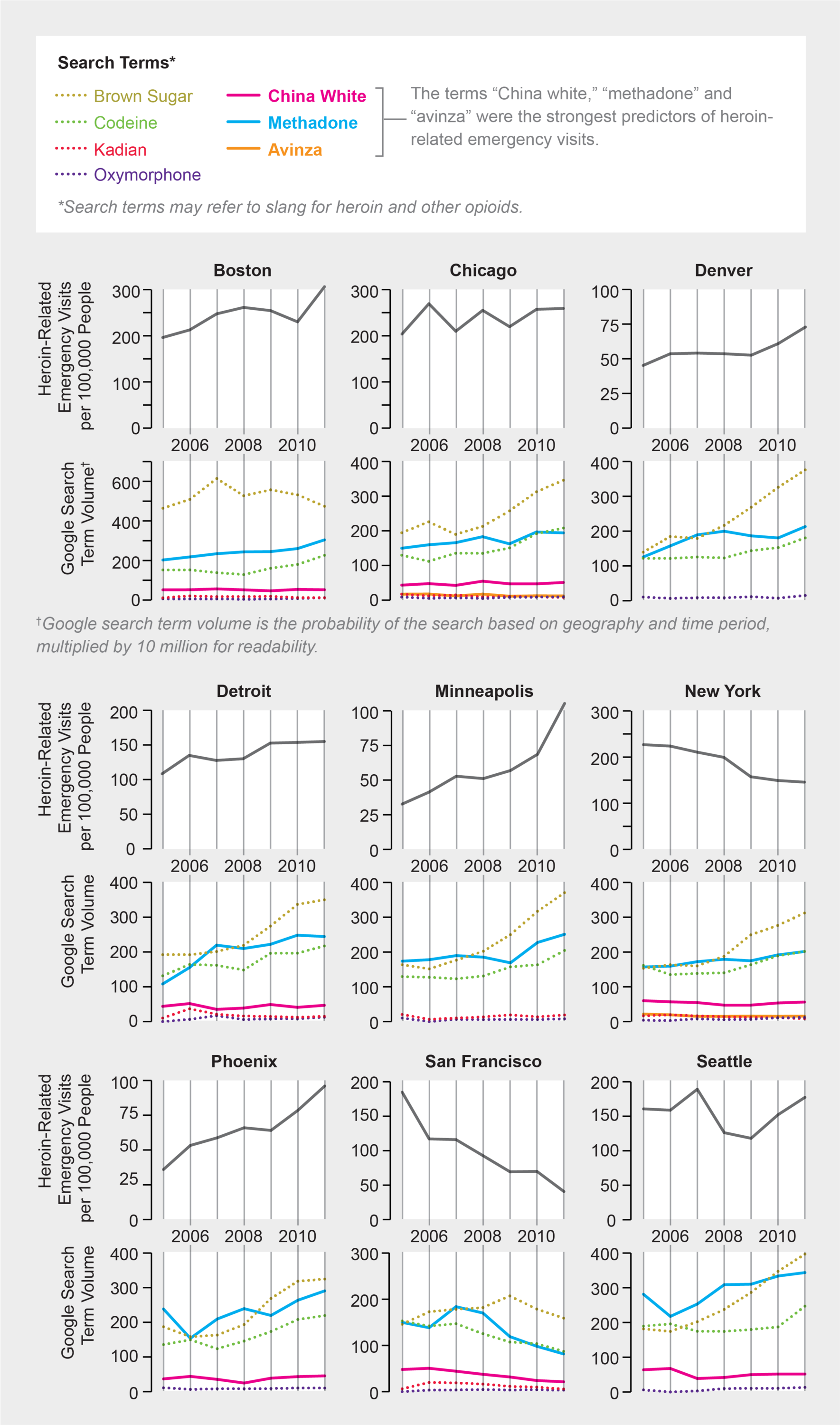
Credit: Amanda Montañez; Source: “Internet Searches for Opioids Predict Future Emergency Department Heroin Admissions,” by Sean D. Young et al., in Drug and Alcohol Dependence, Vol. 190; September 1, 2018