
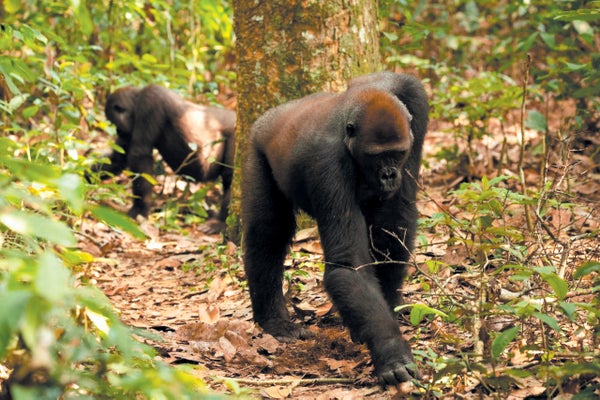
Gaston Abea remembers his grandfather telling him that the gorillas living near their village in the northern Republic of the Congo were digging at the soil in search of tasty ants. Abea believed this explanation for the odd behavior—until he watched it closely himself and decided it didn’t quite line up with the reason given by his grandfather or other members of his Indigenous Ba’Aka community.
“The gorillas were putting the leaves aside and really scratching the soil,” Abea says. “That’s not how you’d search for ants: you’d just pick them up.”
Abea, now a Wildlife Conservation Society research assistant in Congo’s Nouabalé-Ndoki National Park, was intensely curious about what the gorillas were actually up to. After several years of study, he and his colleagues revealed the answer in the journal Primates, offering a rare glimpse into gorilla diet and culture: the great apes were foraging for truffles.
On supporting science journalism
If you're enjoying this article, consider supporting our award-winning journalism by subscribing. By purchasing a subscription you are helping to ensure the future of impactful stories about the discoveries and ideas shaping our world today.
Other researchers had observed gorillas scratching at soil in a few places in Congo, Gabon and the Central African Republic, and they had also assumed it was an insect-foraging strategy. Abea and his colleagues cleared things up by following four groups of Ndoki gorillas for years, documenting their actions and collecting specimens of the small, round objects they saw the apes picking up and eating from the scratched earth.
Taxonomic and molecular analysis revealed that the subterranean morsels were Elaphomyces labyrinthinus, a truffle species that looks like a smaller version of the kind humans eat. Not all the area’s gorilla groups engaged in regular soil scratching, but all seemed capable of it. One individual doubled the time she spent consuming truffles after she switched from a group that rarely foraged for the fungi to one that frequently did. Such observations suggest that truffle-foraging strategies are flexible and might be socially transmitted rather than linked to some environmental factor.
Culture is less well studied in gorillas than in other great apes. Primatologists have also traditionally written off gorilla feeding habits as less interesting than those of chimpanzees and orangutans, which have more varied diets and are avid tool users. The new paper adds evidence, however, that gorilla diets “are remarkably diverse and that there may be cultural preferences for certain foods in certain social groups,” says Stacy Rosenbaum, a biological anthropologist at the University of Michigan, who was not involved in the new study.
Scientists don’t yet know why these difficult-to-find delicacies would be on a gorilla’s menu. Some research suggests truffles might have antimicrobial, antioxidant and anti-inflammatory properties, Rosenbaum says—so “an intriguing, if speculative, possibility is that they might have medicinal benefits.” Or it could be that some gorillas, like some humans, simply find them delicious.