The Bird Family Tree Gets a Makeover

In the most thorough genomic investigation to date, some birds perch on new branches

Jen Christiansen

Join Our Community of Science Lovers!

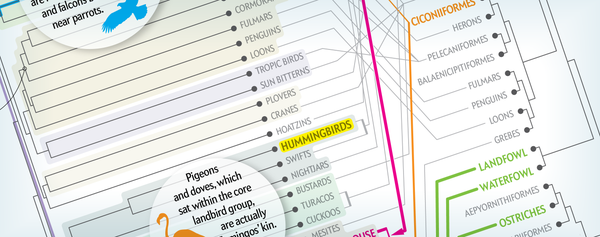
Classifying birds by plumage and other anatomical features served scientists well over the centuries, but genetic analyses have opened up a world of detail about avian family ties. An international group of researchers recently developed a tree based on the full genomes of 48 species, representing every major bird lineage—the most thorough genetic study of a large branch on the tree of life to date. The massive effort, with more than 200 collaborators, includes investigations of the emergence and disappearance of teeth, the origin of vocal learning, and the timing of the explosion of bird diversity.

The new tree confirms many past observations, such as the common ancestor of the core landbirds. It also resolves some controversial links. Who might have guessed, for instance, that pigeons and flamingos are close cousins?

Credit: Jen Christiansen; Sources: “Whole-genome analyses resolve early branches in the tree of life of modern birds,” by Erich D. Jarvis et al., in Science, Vol. 346; December 12, 2014 (left tree); “Higher-order phylogeny of modern birds (Theropoda, Aves: Neornithes) based on comparative anatomy,” Part II: “Analysis and discussion,” by Bradley C. Livezey and Richard L. Zusi, in Zoological Journal of the Linnean Society, Vol. 149, No. 1; January 2007 (right tree)


On supporting science journalism

If you're enjoying this article, consider supporting our award-winning journalism by subscribing. By purchasing a subscription you are helping to ensure the future of impactful stories about the discoveries and ideas shaping our world today.


More classification notes:

In addition to 48 bird genomes, the researchers sequenced three crocodilian genomes to pinpoint early descendent relationships.

The separation of penguins, pelicans and ibis from flamingos and grebes (and pigeons) implies that the waterbird trait evolved independently multiple times.

Because of how quickly both land birds and waterbirds evolved, the data suggests that the original ancestors might have been birds that lived along the coastline.

Chickens share the most DNA with the first bird ancestor, closely followed by hoatzin and emu.

Sarah Lewin Frasier is a senior editor at Scientific American. She plans, assigns and edits the Advances section of the monthly magazine, as well as editing online news, and she launched Scientific American’s Games section in 2024. Before joining Scientific American in 2019, she chronicled humanity’s journey to the stars as associate editor at Space.com. (And even earlier, she was a print intern at Scientific American.) Frasier holds an A.B. in mathematics from Brown University and an M.A. in journalism from New York University’s Science, Health and Environmental Reporting Program. She enjoys musical theater and mathematical paper craft.

More by Sarah Lewin Frasier
Scientific American Magazine Vol 312 Issue 4This article was published with the title “A Genetic Guide to Birds” in Scientific American Magazine Vol. 312 No. 4 (), p. 84
doi:10.1038/scientificamerican0415-84

It’s Time to Stand Up for Science

If you enjoyed this article, I’d like to ask for your support. Scientific American has served as an advocate for science and industry for 180 years, and right now may be the most critical moment in that two-century history.

I’ve been a Scientific American subscriber since I was 12 years old, and it helped shape the way I look at the world. SciAm always educates and delights me, and inspires a sense of awe for our vast, beautiful universe. I hope it does that for you, too.

If you subscribe to Scientific American, you help ensure that our coverage is centered on meaningful research and discovery; that we have the resources to report on the decisions that threaten labs across the U.S.; and that we support both budding and working scientists at a time when the value of science itself too often goes unrecognized.

In return, you get essential news, captivating podcasts, brilliant infographics, can't-miss newsletters, must-watch videos, challenging games, and the science world's best writing and reporting. You can even gift someone a subscription.

There has never been a more important time for us to stand up and show why science matters. I hope you’ll support us in that mission.

Thank you,

David M. Ewalt, Editor in Chief, Scientific American

Subscribe