Gravitational Waves and the Poetry of Blackfoot

Science in meter and verse

LIGO, CALTECH, M.I.T. AND AURORE SIMONNET SONOMA STATE UNIVERSITY

Join Our Community of Science Lovers!

Edited by Dava Sobel

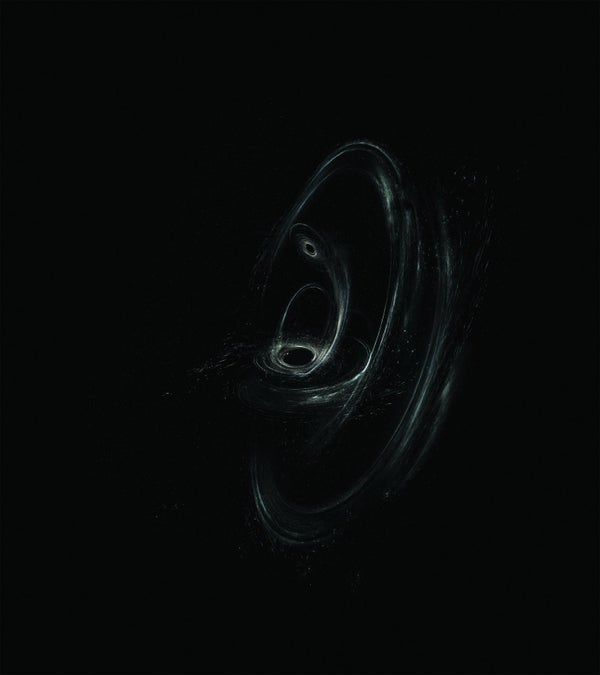
When we first detect the chirp of black holes colliding,
she renders the press release into disappearing language:
        “Light splitter and union of instruments”       (speak, interferometer)
        “Self-strengthened lights exploding”          (speak, gamma rays).
Such subtle “bird songs” are undone by gravitational waves,
we are compelled to fix their fugitive features.

In glaciers, nature deviates and also runs its course—
its layers not quite memory, but more like artifice:
        snow's structure, changed under so much weight
        the geometry of flakes collapses, heavy cold
               compressing air, deforming firn.
The cold is a formalist: it constructs a made thing, temporary,
        describing ancient climate feedbacks as it melts.


On supporting science journalism

If you're enjoying this article, consider supporting our award-winning journalism by subscribing. By purchasing a subscription you are helping to ensure the future of impactful stories about the discoveries and ideas shaping our world today.


How elusive the object, how we read impermanence in layers
        of ice so compressed
               its expansion can shatter glass
       of ice so deep you can no longer discern sequence,
               its layers folding and sliding into the nonlinear,
       as effortful as astrophysics in Siksika,
               somehow still legible.

We must consider and reconsider
               freezing and thawing,
       a girl punished for speaking in her native tongue,
       the defiance in resurrecting an idea whose circumference
swells and contracts, an artifact of water and sky,
revealing the dual meanings of sublime
       its magnificence, its vaporizing solidity—
which, I say, is proof of something, if it doesn't save us.

AUTHOR'S NOTE: Astrophysicist Corey Gray, a member of the Laser Interferometer Gravitational-wave Observatory (LIGO), asked his mother, Sharon Yellowfly, to translate the LIGO press release on the detection of gravitational waves into Blackfoot.

Jessica Reed, who studied physics at Purdue University, is author of the collection World, Composed (Finishing Line Press, 2018). She has taught science poetry courses in Beijing and Saudi Arabia, as well as in the U.S., most recently at Butler University near her home in Indiana.

More by Jessica Reed
Scientific American Magazine Vol 323 Issue 2This article was published with the title “As the Knud Rasmussen Glacier Calves, a Woman Translates “Gravitational Waves” into Blackfoot” in Scientific American Magazine Vol. 323 No. 2 (), p. 22
doi:10.1038/scientificamerican0820-22

It’s Time to Stand Up for Science

If you enjoyed this article, I’d like to ask for your support. Scientific American has served as an advocate for science and industry for 180 years, and right now may be the most critical moment in that two-century history.

I’ve been a Scientific American subscriber since I was 12 years old, and it helped shape the way I look at the world. SciAm always educates and delights me, and inspires a sense of awe for our vast, beautiful universe. I hope it does that for you, too.

If you subscribe to Scientific American, you help ensure that our coverage is centered on meaningful research and discovery; that we have the resources to report on the decisions that threaten labs across the U.S.; and that we support both budding and working scientists at a time when the value of science itself too often goes unrecognized.

In return, you get essential news, captivating podcasts, brilliant infographics, can't-miss newsletters, must-watch videos, challenging games, and the science world's best writing and reporting. You can even gift someone a subscription.

There has never been a more important time for us to stand up and show why science matters. I hope you’ll support us in that mission.

Thank you,

David M. Ewalt, Editor in Chief, Scientific American

Subscribe