
On supporting science journalism
If you're enjoying this article, consider supporting our award-winning journalism by subscribing. By purchasing a subscription you are helping to ensure the future of impactful stories about the discoveries and ideas shaping our world today.
On September 14, 2015, lasers in aboveground tubes in Louisiana and Washington State wavered together in response to a disturbance in spacetime, and a new window opened onto the cosmos. The two sites are part of the LIGO gravitational-wave detector—sensitive, powerful lasers so carefully isolated from Earth’s motion they can pick up incredibly minuscule vibrations. The signal was a gravitational wave, a ripple in spacetime created by two black holes merging 1.4 billion light-years away, far beyond our Milky Way galaxy. The event—the first detection of gravitational waves—also proved that black holes can orbit each other and merge. Since then, sensors have detected 49 more events, making them seem almost commonplace, says LIGO team member Christopher Berry. The accumulating data are helping astronomers better understand the menagerie of objects that populate the universe.
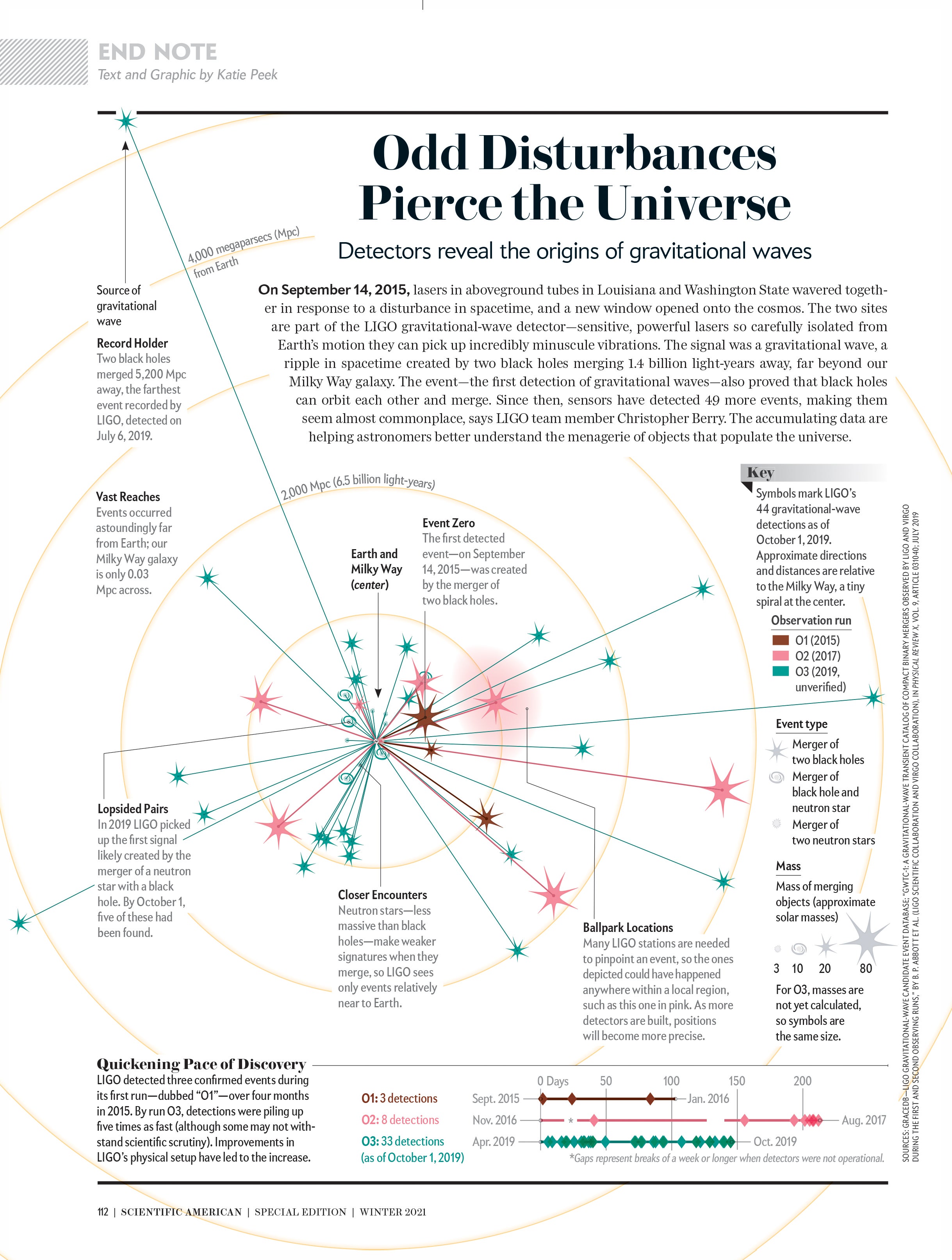
Credit: Katie Peek; Source: LIGO Gravitational-Wave Candidate Event Database; “GWTC-1: A Gravitational-Wave Transient Catalog of Compact Binary Mergers Observed by LIGO and VIRGO during the First and Second Observing Runs,” by B. P. Abbott et al. (LIGO Scientific Collaboration and Virgo Collaboration), in Physical Review X, Vol. 9, article 031040; July 2019