
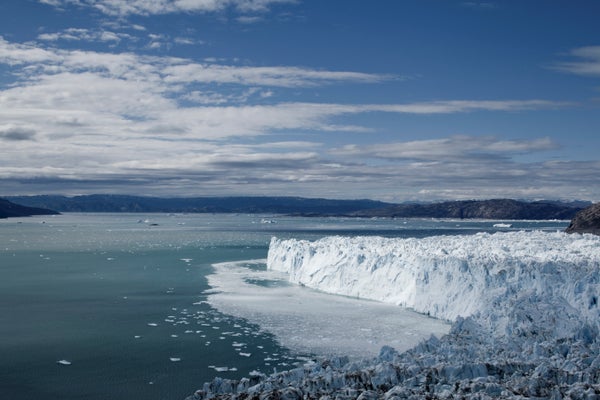
The Greenland ice sheet may be even more sensitive to the warming climate than scientists previously thought.
A new study finds that rising air temperatures are working with warm ocean waters to speed the melting of Greenland’s seaside glaciers.
The findings, published in the journal Nature Geoscience, shed new light on the forces driving ice loss on the world’s second largest ice sheet.
On supporting science journalism
If you're enjoying this article, consider supporting our award-winning journalism by subscribing. By purchasing a subscription you are helping to ensure the future of impactful stories about the discoveries and ideas shaping our world today.
The Greenland ice sheet is losing an average of around 250 billion metric tons of ice per year. These losses are speeding up over time, studies have found—and there are two main processes causing it.
Warm air temperatures cause melting to occur on the surface of the ice sheet—that process accounts for about half the ice Greenland loses each year. The other half comes from glaciers at the ice sheet’s edge crumbling into the sea.
Losses from these seaside glaciers have, until now, been mainly attributed to warm ocean waters licking at the edge of the ice. But the new research finds that rising air temperatures have a big influence as well.
Warm air causes the surface of the ice sheet to melt, and that meltwater then runs off into the ocean. When that happens, it churns up the waters—and that turbulence helps heat rise up from the depths of the ocean and warm up the waters coming into contact with the ice. That, in turn, melts the glaciers faster.
Lead study author Donald Slater, a scientist at the University of Edinburgh, likened the process to ice cubes in a glass of water. They clearly melt faster when the water is warmer. But they also melt faster when the water is stirred.
Rising air temperatures in Greenland “effectively result in a stirring of the ocean close to the ice sheet, causing faster melting of the ice sheet by the ocean,” he said in a statement.
The researchers used a combination of observations and models to investigate the melt rates at the edges of Greenland’s oceanfront glaciers, and then to tease out the roles of ocean versus atmosphere.
They found that glaciers in south Greenland are melting the fastest. That wasn’t a surprise—these glaciers are closest to the warm Atlantic Ocean. In these areas, the models suggest that warm waters play the dominant part in melting the ice.
Glaciers in the northern parts of the ice sheet, on the other hand, are exposed to colder waters and tend to melt at slower rates. In these places, the ocean is still the bigger influence—but air temperatures play a more substantial role.
The study concludes that warming air temperatures have had a major hand in speeding up the losses from Greenland’s crumbling glaciers. If the atmosphere hadn’t warmed over the last few decades, the research finds, the retreat of Greenland’s glaciers as a whole likely would have been reduced by as much as a third. In northwestern Greenland, it could have been reduced by as much as half.
“This unfortunately adds to the overwhelming body of evidence showing the sensitivity of the Greenland ice sheet to climate change, hence the need for urgent action to reduce greenhouse gas emissions,” Slater said.
Reprinted from E&E News with permission from POLITICO, LLC. Copyright 2022. E&E News provides essential news for energy and environment professionals.