
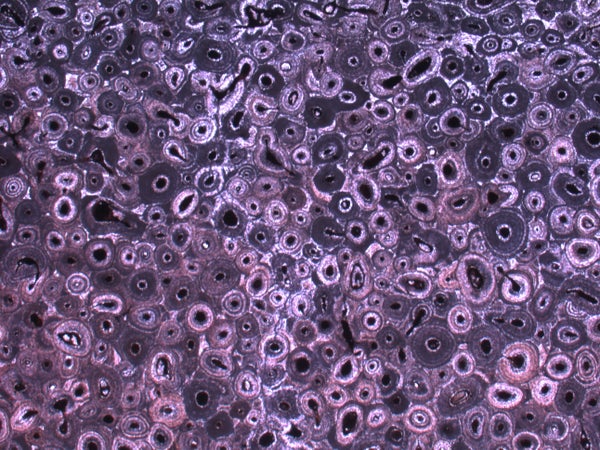
Around 80 million years ago in what is now Brazil, a sick dinosaur limped along—but its days were numbered. Its leg bone was so diseased that it had turned spongy, and a particularly gruesome culprit may have been to blame: wormlike parasites wriggling through its bloodstream. Researchers analyzing the fossilized bone recently found strange, oblong forms in channels that once were blood vessels. The dinosaur in question was a titanosaur, a large long-necked animal.*
After initially noticing abnormalities in the leg bone, Aline Ghilardi at Brazil’s Federal University of Rio Grande do Norte, along with her colleagues, set out to discover what ailed the titanosaur. They ruled out cancer and tuberculosis; these often reduce blood flow in affected bone areas, but this fossil’s irregular surface suggested it had once been riddled with vascular canals coursing with blood and pus. A CT scan also revealed internal cavities probably associated with blood flow.
The researchers concluded that this titanosaur had a rare bone condition called osteomyelitis, which causes severe inflammation. When they cut thin slices of the fossil, coated them in resin and examined them under a powerful microscope, they got a look at a startling potential cause: scattered through the bone’s blood vessel cavities, they found fossilized remains of what appear to be around 70 tiny worms, each roughly the length of a dust mite.
On supporting science journalism
If you're enjoying this article, consider supporting our award-winning journalism by subscribing. By purchasing a subscription you are helping to ensure the future of impactful stories about the discoveries and ideas shaping our world today.
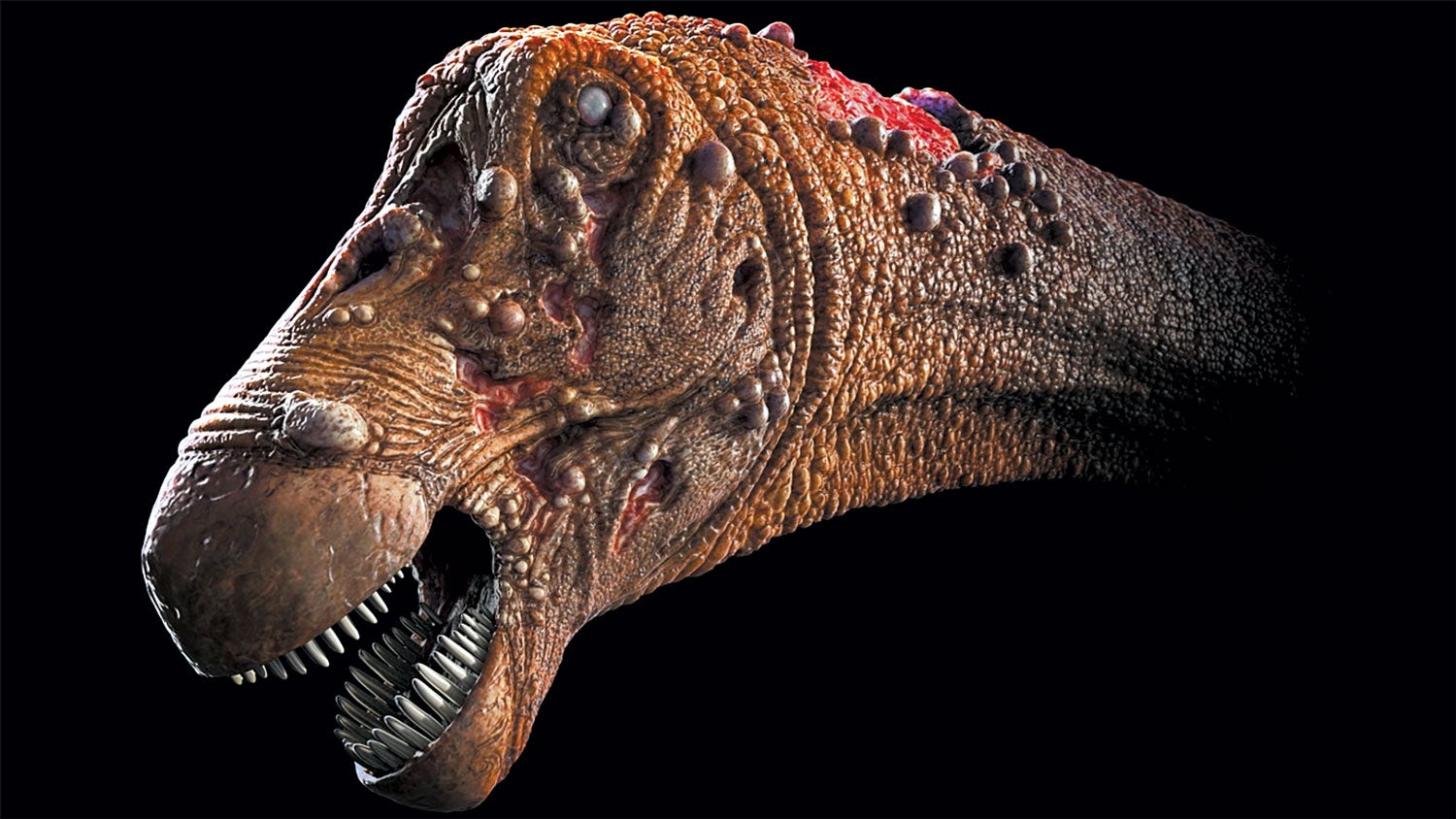
Titanosaur. Credit: Hugo Cafasso
“We were totally shocked,” Ghilardi says. To her knowledge, such organisms have never before been found inside dinosaur bone fossils. “We can’t compare it to anything.”
In a Cretaceous Research article released online in October, she and her colleagues suggest these “worms” could be ancient parasites that invaded the dinosaur’s bone. The researchers note, however, that osteomyelitis can also be caused by bacteria, fungi and single-celled organisms called protozoa. Once inside an animal’s vascular system, these can trigger severe bone inflammation as the body reacts to their presence.
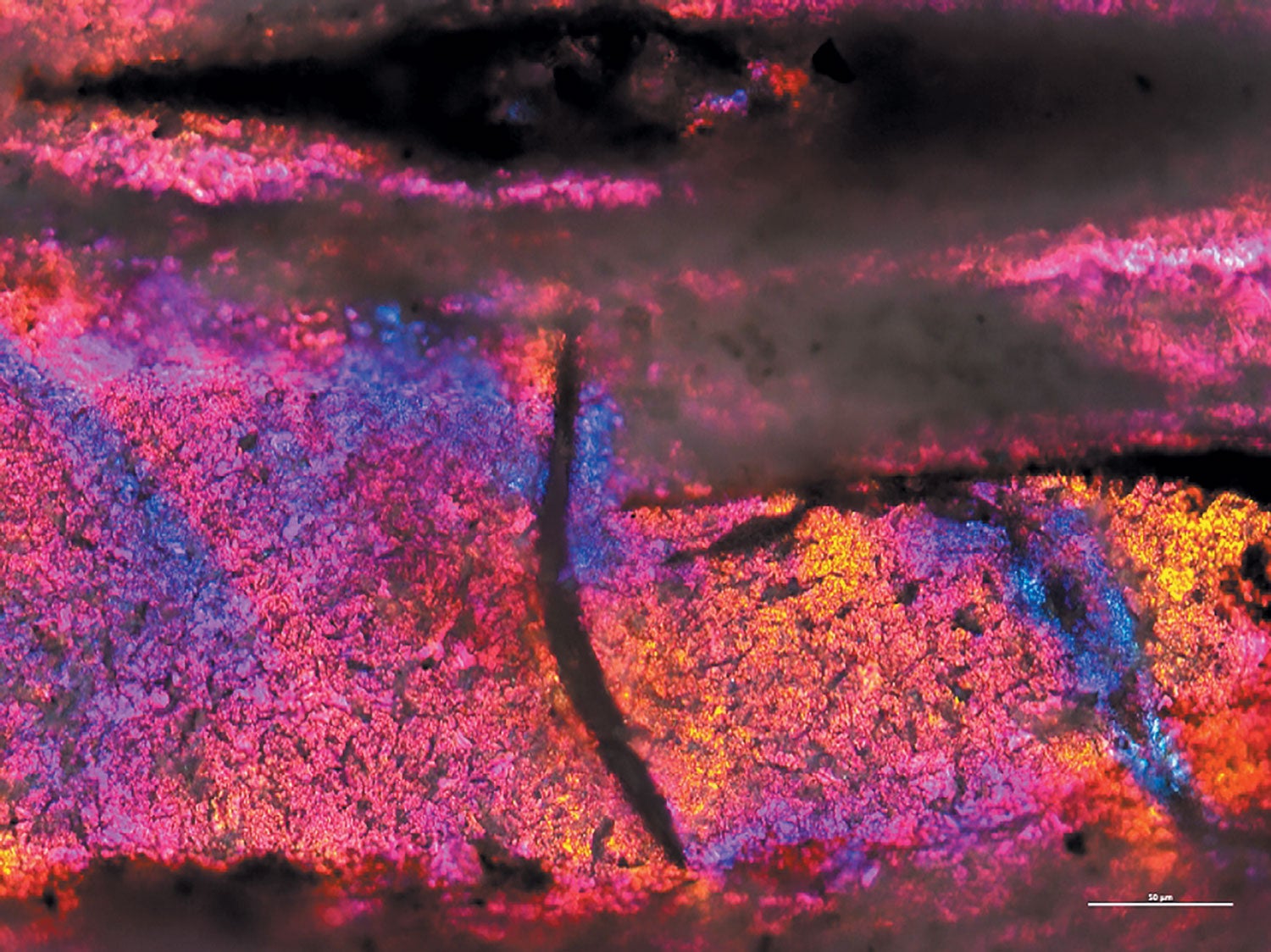
A titanosaur’s nasty bone condition may have come from wormlike invaders. Credit: From “Blood Parasites and Acute Osteomyelitis in a Non-avian Dinosaur (Sauropoda, Titanosauria); From the Upper Cretaceous Adamantina Formation, Bauru Basin, Southeast Brazil,” by Tito Aureliano et al., in Cretaceous Research, Vol. 118; February 2021
The wormlike structures are similar in shape to a known prehistoric parasite called Paleoleishmania—but they are between 10 and 100 times bigger, so their identity remains unconfirmed. Forthcoming work compares them to a broad range of parasites, “and the story keeps getting more and more interesting,” Ghilardi wrote on Twitter.
There could be other explanations, however. “I’m not entirely convinced that those things are parasites, or, if they are parasites, that they have anything to do with the bone diseases,” says Tommy Leung, an ecologist who studies parasite evolution at the University of New England in Australia. Leung was not involved with the research, though he was a reviewer on a previous version of the paper.
If the wormlike forms were indeed living organisms, they could have entered the bone to feed on the dinosaur after it died. But the researchers argue that this is unlikely because there were no obvious fractures that such creatures might have invaded after the animal’s death.
.jpg?w=2000)
Replica of the titanosaur at the American Museum of Natural History in New York City. Credit: Spencer Platt Getty Images
Parasites are known to affect birds and reptiles today, so it makes sense that they troubled dinosaurs, too, says Paul Barrett, a paleobiologist at the Natural History Museum in London, who also was not involved with the research. To him, the fossilized objects found in Brazil look like nematodes.
“It’s a really neat study,” Barrett says, “and it shows that by applying a range of techniques in this case to a single bone, you can get a lot of information about the biology of an individual dinosaur.”
A version of this article with the title “Blood Worms” was adapted for inclusion in the January 2021 issue of Scientific American.
*Editor’s Note (11/9/20): This paragraph was revised after posting to avoid implying that a reference to the size of titanosaurs in general describes the particular fossil discussed.