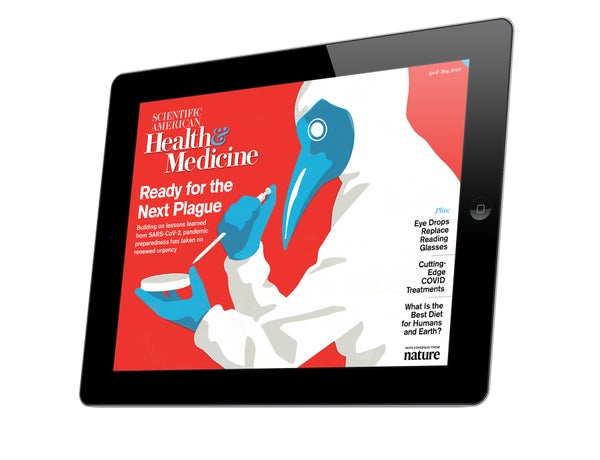
Scientific American Health & Medicine, April/May 2022
Join Our Community of Science Lovers!
The COVID pandemic is by no means over. Despite plunging case numbers in the U.S. as of this writing, many countries in the world are still experiencing peak infection rates. And it is impossible to foresee how the SARSCoV- 2 saga will unfold in the coming months or years. Since 2020 in this country (and others), hard truths about our deficient health-care system, rampant societal inequality and flawed policy-making engine, to name a few, have crystallized—painfully in some cases.
At the same time, vaccine technology, spurred by the successful deployment of mRNA shots, has catapulted progress on treatments for a slew of other infectious diseases from malaria to cancer (as writer Mike May detailed last year). And medicines for COVID itself are under such intense research and development, that several powerful remedies are currently available, with more in the pipeline (see “These Are the Latest COVID Treatments”). Such advancements are only part of a new arsenal of strategies for confronting a future challenged by COVID and any other virus that might arise (see “Preparing for the Next Plague”). It’s too flip to call this progress a silver lining in the midst of so much toil and grief. But it is a significant win.
Subscribe to Support Independent Journalism
Great science journalism requires human expertise, time, effort and creativity. And it costs money. That’s why I and the journalists here at Scientific American hope you’ll join our community.
When you subscribe, you are supporting staff and freelance journalists who are passionate about telling science stories that are true, important and compelling. Our editors and reporters are often experts in their fields, which means they understand the nuances of big discoveries and can untangle the breakthroughs from the hype. With a subscription, you are also supporting rigorous fact-checking to ensure the words we publish are precise and accurate. And you’re supporting original illustrations, graphics and photos that bring you closer to an advanced laboratory, an ice sheet in Antarctica or a space mission in orbit. You’re helping us craft other types of high-quality journalism as well: Our newsletters are carefully written, edited and curated by staffers you have or will come to know and love. Our Science Quickly podcast is based on original reporting, collaboration with editors and scientists and exacting production.
Subscriptions keep this engine running so we can continue to deliver thoughtful, rigorous and independent science journalism to you. In an era of viral misinformation, this work is crucial. If you value what we do, I hope you’ll consider joining us as a subscriber
Thank you,
Jeanna Bryner, Editor in Chief, Scientific American