
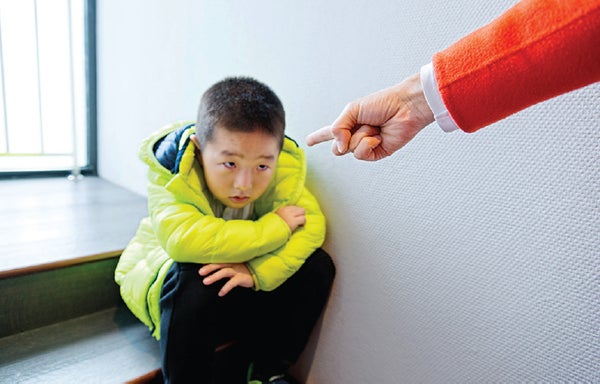
The consensus is clear: mean parents make mean kids—and the victims of mean kids. Several recent studies confirm an association between strict parenting styles and children's likelihood of both being a bully and being bullied. Some work also points to a more surprising association—permissive or neglectful parenting might create bullies, too.
In one such study, researchers at the University of Washington and Arizona State University conducted a retrospective study of 419 college students and found that parental authoritativeness—in which parents are warm and caring but set rules for the sake of their child's safety—lowered kids' risk of being bullied. Both permissive and authoritarian (strict) parenting styles, on the other hand, were positively correlated with bullying other kids, according to the results published in January in Substance Use and Misuse. Both approaches can result in a lack of respect for rules and the rights of others.
A 2012 study in the Journal of Cybertherapy and Rehabilitation also pointed to lackadaisical parenting as a problem. Researchers investigated online bullying in a sample of college students and found that those with permissive parents had engaged in more bullying behaviors than participants with authoritarian and authoritative parents. Neglectful parenting was associated with the most bullying.
On supporting science journalism
If you're enjoying this article, consider supporting our award-winning journalism by subscribing. By purchasing a subscription you are helping to ensure the future of impactful stories about the discoveries and ideas shaping our world today.
Most research on parents' influence on bullying, however, has focused on harsh, punitive parenting styles—in which the parents are essentially modeling bullying behavior for their children. One such study, published in January in Child Abuse and Neglect, assessed bullying involvement, parenting styles and disciplinary practices in a sample of 2,060 Spanish high school students. Results indicate that abusive discipline increased teenagers' risk of abusing peers or being abused by them. For girls, the risk of being a bully was more closely connected to physical punishment, whereas for boys it was linked primarily to psychologically aggressive parental discipline. For both boys and girls, there was a direct correlation between falling victim to a bully and psychological aggression from parents.
Taken together, the studies indicate that the best parenting tactics probably fall in the middle of the spectrum. Indeed, studies have shown that a protective factor against being bullied or becoming a bully is having parents who are facilitative, meaning warm and responsive to their children and encouraging of appropriate levels of autonomy (rather than being either controlling or overly permissive). A 2015 study of 215 grade school children, reported in the Journal of Child and Family Studies, found that bullied children were consistently rated by teachers as having less facilitative parenting than nonbullied children. A 2016 study from the Journal of Child Psychology and Psychiatry followed kids for five years and found that those whose parents supported autonomy when the kids were four or five years old bullied less over time than those whose parents showed less support for autonomy.
The bottom line? “If you do not wish to raise a bully, do not bully your own kids,” says Julie A. Patock-Peckham, a psychology professor at Arizona State. “An authoritative parenting style, on the other hand, is protective against so many negative psychological outcomes that people who wish to become better parents should take classes on how to be more authoritative with their children.”