
1969
Heat Pollution
“In the U.S. it appears that the use of river, lake and estuarine waters for industrial cooling purposes may become so extensive in future decades as to pose a considerable threat to fish and to aquatic life in general. The discharge of waste heat into the natural waters is coming to be called thermal pollution. What has aroused ecologists is the ninefold expansion of electric-power production that is in prospect for the coming years with the increasing construction of large generating plants fueled by nuclear energy. In Britain, where streams are small, water is scarce and appreciation of aquatic life is high, the favored artificial device for getting rid of waste heat from power plants has been the use of cooling towers.”
On supporting science journalism
If you're enjoying this article, consider supporting our award-winning journalism by subscribing. By purchasing a subscription you are helping to ensure the future of impactful stories about the discoveries and ideas shaping our world today.
“To a Quasar”
“Twinkle, twinkle, little quasar, Candidate for Occam's razor:
Are you near or are you far? Are you nebula or star,
Emitting all that energy Like any normal galaxy?
Is your message from the dark Sent by positron or quark?
Spectrum lines, though rather faint,
Tell us only what you ain't.
What strange phenomenon's involved
In this enigma, yet unsolved?
Stanley A. Bell, Laguna Hills, Calif.”
The writer was inspired by John Updike's poem in the January 1969 issue and the article on quasi-stellar objects by Geoffrey Burbidge and Fred Hoyle in the December 1966 issue.
1919
Hating Daylight Saving
“When we were informed that a rider attached to the Agricultural Appropriation Bill aimed to kill the Daylight Saving Act, we experienced a distinct shock. When we learned that this opposition was mainly due to the farmers, our astonishment grew apace. They do rise early, to be sure, but the early morning work is taken up with chores. Much of the field work cannot be done until after the dew is off the ground. Last year farmers had difficulty with hired men who insisted on quitting work according to the new summer time. And strange to say the cows stubbornly refused to come home when the sun was high in the skies. However, there was an actual saving in lighting bills and consequently a saving of coal, which we cannot afford to ignore.”
Akeley Film Camera
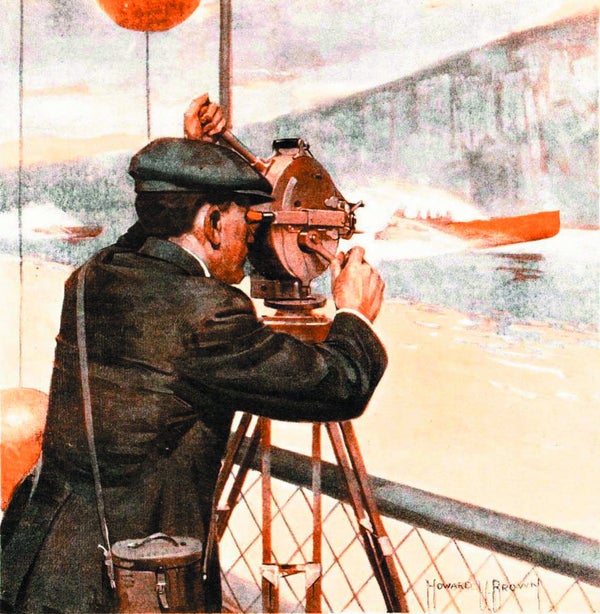
“While doing extensive scientific work in the jungles of Africa, Carl E. Akeley of the staff of the New York Museum of Natural History found the usual type of motion-picture camera inadequate and unreliable for the varied uses of field work. He conceived the principle of the present camera which bears his name. Briefly, the Akeley camera is a one-man camera, in the sense that its operator can carry the camera, magazines, and tripod himself, and set them up without assistance. Twin lenses are employed on the Akeley camera, one for the film and the other for the finder. This arrangement permits of watching the picture on the ground glass, right side up, while operating the camera. Thus the operator can always tell whether his picture is in focus—indeed, he sees exactly what the film is recording at all times. For filming rapidly moving objects, such as motor boats [see illustration], airplanes, athletes, and so on, there can be no doubt that the Akeley camera is in a field by itself.”
1869
The Panama Canal
“The Hon. Caleb Cushing has returned from the capital of Colombia, the most northern of the South American republics, whither he was sent by the Department of State, and the draft of a treaty he there negotiated for the right of way of a ship canal across the Isthmus of Darien, or Panama, is now before the Senate for ratification. The project of uniting the two oceans by a cut across the Siamese-twin ligature that unites the two great western continents and divides the two great oceans is not a new or a modern one.
In 1843 the French government sent out Messieurs Napoléon Garella and J. de Courtines to make explorations. They reported in favor of a canal passing under the dividing ridge of the Ahogayegua by a tunnel 17,390 feet long. With the disastrous expedition of Lieut. Strain [of the U.S. Navy, 1854], probably all or most of our readers are familiar. A railroad tunnel scarcely 20 feet wide is possible, while one to accommodate ships is a feat at which even modern engineering may stand aghast. A canal, however, is proposed now, and one without tunnels.”
The Panama Canal was not opened until 1914.
