
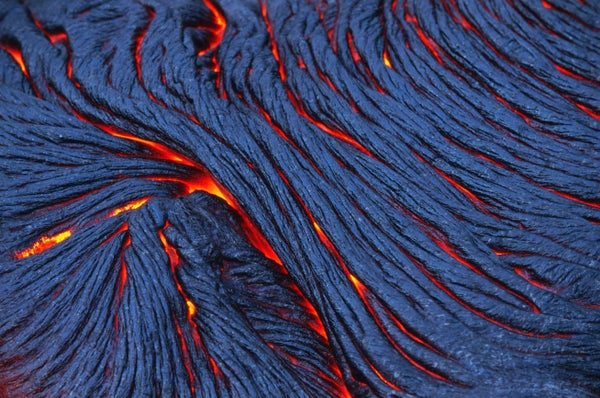
Long before outsiders arrived on the scene, Native Hawaiians understood their island chain’s volcanic origins. They also understood the island links were successively younger moving from northwest to southeast. In Hawaiian tradition the fire and volcano goddess Pele is thought to occupy the youngest and most active center of volcanism. Today that is Kilauea on the Big Island of Hawaii.
In the 21st century scientists are now able to put numbers to the island ages, ranging from around five million years at the oldest end up to the present day (at Kilauea). The young volcano is now experiencing one of many eruptions that over time have built it into a rather classic “shield volcano” composed of gentle lava flows, embroidered with two radial rift zones—one to the southwest and one to the east—where magma reaches the surface. Scientists have also identified an active seamount named Lihi growing at about 3,000 feet below sea level off the coast southwest of Kilauea.
The current east rift eruption at Kilauea, which has already destroyed hundreds of homes and changed the island’s topography, reminds us that the subsurface structure of a typical Hawaiian volcano includes an interconnected “plumbing system” of storage chambers and passageways for molten rock (magma) that rises from its deep source in Earth’s hot and restless mantle (the layer beneath the crust). The styles of eruption vary, from oozing out of linear vertical fissures to fountains of a few to hundreds of feet tall. Fountaining results from magma that contains dissolved gaseous substances (think: carbonated beverage) that escape violently when confining pressure is rapidly reduced. Explosive action may also occur when lava flows into seawater and the 2,000-degree Fahrenheit molten rock boils it. The final products of the various styles of eruption range from hairlike strands to tearlike droplets to solid layers of lava-flow rock, along with atmospheric contamination.
On supporting science journalism
If you're enjoying this article, consider supporting our award-winning journalism by subscribing. By purchasing a subscription you are helping to ensure the future of impactful stories about the discoveries and ideas shaping our world today.
Here are some examples of these phenomena, as they are often referred to in Hawaii.
