
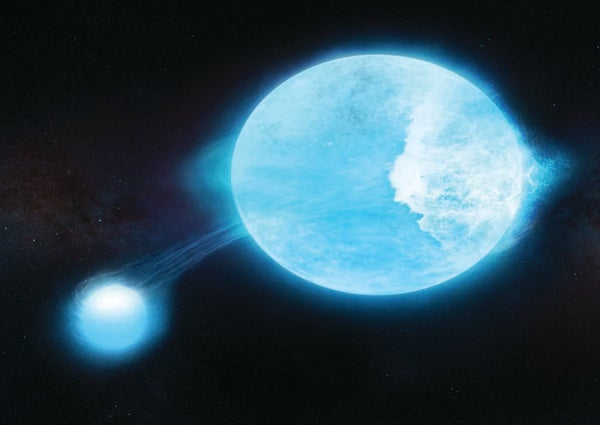
As the tide rolls in on an ocean beach, waves crash in a spray of saltwater and foam. Light-years from Earth a similar scene is playing out on a vastly larger scale as waves of hot gas swell to the height of three of our suns and then collapse onto the surface of a supergiant star, according to a recent study in Nature Astronomy.
In eccentric two-star systems called “heartbeat” stars, one star distorts its partner's shape as they orbit each other—a bit like how the moon creates ocean tides as it orbits Earth. These stellar tides of hot gas, which typically bulge to a height of about 0.1 percent of the star's overall diameter, cause variations in the star system's brightness that astronomers can detect on Earth.
There's something wildly different about MACHO 80.7443.1718, a system 200,000 light-years away, says study co-author Morgan MacLeod, an astrophysicist at the Center for Astrophysics | Harvard & Smithsonian. This system's smaller star has been causing tides on its giant companion with amplitudes reaching 20 percent of the larger star's size, distorting it into a shape “like a rugby ball,” MacLeod explains. “How can it support a wave this big?” he wonders.
On supporting science journalism
If you're enjoying this article, consider supporting our award-winning journalism by subscribing. By purchasing a subscription you are helping to ensure the future of impactful stories about the discoveries and ideas shaping our world today.
In short, it can't. MacLeod and his colleague Abraham Loeb created a computer model of the stars' movements and found that the system will eventually be unable to sustain such giant waves. The orbit distance is shrinking, and the spray of hot gas and debris from the waves is causing the larger star to lose mass. The researchers nicknamed this doomed pair “heartbreak” stars.
“In this system, the stars come quite close to each other during their orbit,” says James Fuller, an astrophysicist at the California Institute of Technology, who was not involved in the new study. “You get a much more violent reaction than we normally see in other systems.” The stars draw closer together with each passing year as the larger one, 35 times the mass of our sun, siphons energy from its smaller companion. MacLeod expects the waves will become only more powerful as the orbit shrinks further. Physicists don't know yet whether such stars eventually collide and merge into one.
Studying binary-star interactions might help astrophysicists predict the system's ultimate fate, says Susan E. Mullally, an astronomer at the Space Telescope Science Institute, who didn't take part in the study. At the end of their lives massive stars either collapse into black holes or stall out as neutron stars—but for these so-called heartbreak stars, scientists don't know which it will be.
“If a significant part of [a massive star's] life is spent interacting with another star,” Mullally says, then this may have “interesting influences in the final evolution of what happens to binary stars.”