
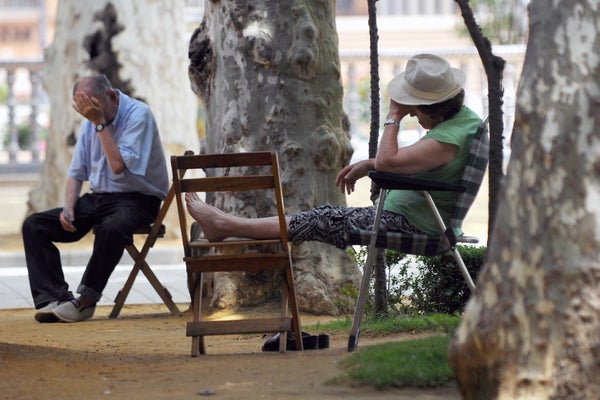
Seville, Spain, announced yesterday a new program to combat deadly heat. It plans to start naming and ranking its heat waves, similar to tropical storms and hurricanes.
It will be the first city in the world to implement such a system, according to officials speaking at a public announcement yesterday.
The initiative “is very much in line with the profile of Seville, a city that is fighting for sustainability and against climate change, and a city that is helping to adapt to the current climate change effects,” said Seville Mayor Juan Espadas.
On supporting science journalism
If you're enjoying this article, consider supporting our award-winning journalism by subscribing. By purchasing a subscription you are helping to ensure the future of impactful stories about the discoveries and ideas shaping our world today.
Seville is working in partnership with the Adrienne Arsht-Rockefeller Foundation Resilience Center, an initiative of the Atlantic Council, an international affairs think tank based in Washington. Last year, the center launched its new Extreme Heat Resilience Alliance, aimed at tackling the issue of extreme urban heat.
One of its primary goals is to encourage meteorological organizations worldwide to name heat waves and categorize them by severity. The idea is to raise public awareness about the health risks of extreme heat events and to help communities better prepare for them.
In Seville, the new program includes collaborations with both local and national science institutions, including Spain’s national weather service and its climate change office, the University of Seville and Pablo de Olavide University in Seville.
By naming and ranking heat waves, Espadas said, the city can “increase our preparedness both at the citizen level as well as the health care facilities level, the hospitals and other health care centers.”
Extreme heat is a pressing concern for the city, Espadas said. Andalusia, the southernmost region of Spain where Seville is located, is a territory “particularly threatened by climate change,” he said.
Earlier this summer, the Andalusian city of Montoro—about 100 miles northeast of Seville—saw temperatures soar to a blistering 117.3 degrees Fahrenheit. It was the hottest temperature ever recorded in Spain.
The record-breaker occurred during a prolonged heat wave in southern Europe.
While Seville is the first city to formally launch such a program, others have considered it. After Greece suffered several intense heat waves this summer, some Greek scientists called for a naming system.
Kostas Lagouvardos, research director at the National Observatory of Athens, told The Observer (a sister newspaper of The Guardian) in August that “people will be more prepared to face an upcoming weather event when the event has a name.”
Ranking heat waves may be more challenging, he acknowledged. Both population density and the distribution of temperatures can affect the severity of an extreme heat event.
It’s an issue that other experts have raised as well.
Larry Kalkstein, a heat and human health expert at the University of Miami, told The Washington Post last year that heat waves can be difficult to define—they could be ranked by any number of different categories, including maximum temperature, minimum temperature and how long they persist.
The same event also wouldn’t necessarily have the same health impact in different locations. Scientists often point out that the health impacts of extreme heat are tied to local conditions, including the local climate, urban design, infrastructure and emergency initiatives, such as access to cooling centers.
While it’s unclear whether naming and ranking heat waves will catch on elsewhere, scientists are increasingly sounding the alarm about the health risks of extreme heat.
Heat is the biggest weather-related killer in the United States. And it’s only getting worse—heat waves are growing more frequent and more severe as the climate continues to warm.
Extreme heat also disproportionately affects certain communities. Elderly people, people with certain underlying medical conditions and people without access to air conditioning are among the most vulnerable to heat-related illness and death.
Low-income communities and people of color also tend to be more vulnerable to the impacts of extreme heat. In cities across the country, these communities are likely to live in hotter neighborhoods, often because of denser housing, fewer green spaces and other aspects of urban design. They’re also likely to be exposed to higher levels of air pollution, which can worsen the health effects of extreme heat.
As a result, experts have urged city officials to prepare in advance for increasingly severe heat events, keeping their most vulnerable populations in mind.
The program in Seville is one effort to keep communities informed about the dangers of extreme heat.
“A major component of our work is focused on protecting the lives and livelihoods of urban residents from extreme heat, particularly the most vulnerable,” said Kathy Baughman McLeod, director of the Adrienne Arsht-Rockefeller Foundation Resilience Center, at yesterday’s announcement. “By categorizing heat waves based upon their projected health impact, Mayor Espadas is arming residents with the power of lifesaving information and actions to prevent harm.”
Reprinted from E&E News with permission from POLITICO, LLC. Copyright 2021. E&E News provides essential news for energy and environment professionals.