
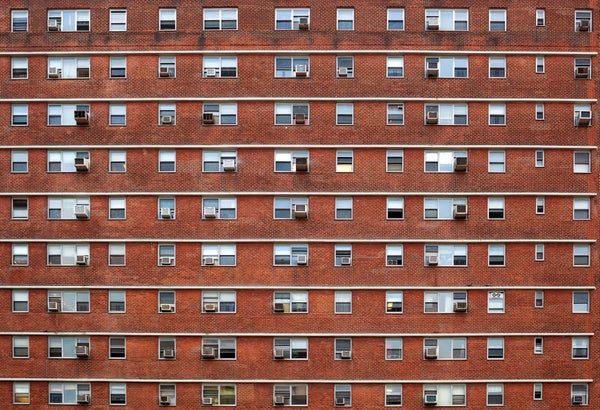
CLIMATEWIRE | Longer and hotter summers are increasing the cost of cooling homes, threatening to leave low-income people unable to afford air conditioning as temperatures skyrocket because of climate change.
A report released Monday by a group representing state energy officials says the average U.S. electric bill could hit $720 this summer — more than 50 percent higher than in 2014 — largely because global warming is intensifying heat and forcing people to use more air conditioning.
In the mid-Atlantic and Pacific Coast, electric bills are expected to go up 12 percent this year alone.
On supporting science journalism
If you're enjoying this article, consider supporting our award-winning journalism by subscribing. By purchasing a subscription you are helping to ensure the future of impactful stories about the discoveries and ideas shaping our world today.
“Usage is going up. This is not going to change … unless something is done about rising temperatures,” said Mark Wolfe, executive director of the National Energy Assistance Directors Association.
Heating costs, by contrast, are not increasing as steadily as the price of cooling but are “more volatile” because of annual changes in fuel costs and usage, Wolfe said.
NOAA’s latest national forecast indicates that temperatures will likely be above average across the nation in July, August and September. The forecasters were even more confident about the Southwest being hotter than normal.
Many low-income households are in difficult financial conditions after paying high heating costs this winter. The association estimates that 21 million households are behind in paying their energy bills, amounting to $20 billion in past-due payments to utilities.
Some households have air conditioning but “won’t turn it on because they’re afraid of the bill,” Wolfe said. The association is trying to get utilities to avoid cutting off service during hot weather to households that haven't made their electricity payments.
Most states bar power companies from disconnecting delinquent households during cold weather, but only 17 states prohibit disconnections during hot weather. Some states that have experienced heat waves and allow electricity cutoffs in hot weather are Alabama, Florida, New York, North Carolina and Pennsylvania, according to the association.
“Shutoff rules go back 30, 40 years before we’ve had continuous heat waves,” Wolfe said. “We’re in a very different environment.”
Wolfe said state utility commissions could bar hot-weather disconnections, or utilities could agree to them voluntarily. The federal government could also require states to stop utility disconnections as a condition for receiving energy assistance.
But efforts in Congress to enact such a requirement have stalled due in part to opposition from electric utilities, Wolfe said.
The association also is calling for more federal funding for programs that help low-income households pay energy bills and make their homes energy efficient.
A long-standing Department of Health and Human Services program that gives states money to pay a portion of household energy bills has $4.1 billion this year, which is similar to funding through the 2010s but several million dollars below funding levels during the Covid-19 pandemic.
“We’re woefully under-prepared in terms of money to help families,” Wolfe said.
States receive federal money through the Low Income Home Energy Assistance Program in October and often spend all or most of it during the winter, leaving little to help pay for cooling costs in the summer.
Reprinted from E&E News with permission from POLITICO, LLC. Copyright 2024. E&E News provides essential news for energy and environment professionals.