
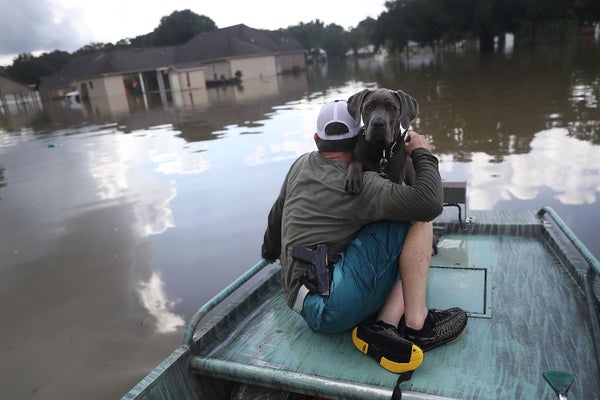
Record-breaking rainfall and flooding may happen more frequently across the United States even if the Paris climate targets are met, new research suggests.
Extreme rainfall events that currently might have only a 1-in-500 chance of happening in any given year—dubbed “500-year” events—may be up to 50 percent more likely under 2 degrees Celsius of climate warming. And the risk of 1,000-year events may increase by twofold to fivefold.
The study, published earlier this month in Geophysical Research Letters, found that the risks will likely increase the most on the East Coast, in the southern Great Plains and in the southern Rocky Mountains.
On supporting science journalism
If you're enjoying this article, consider supporting our award-winning journalism by subscribing. By purchasing a subscription you are helping to ensure the future of impactful stories about the discoveries and ideas shaping our world today.
The projections are more uncertain under higher levels of warming, but the study suggests risks are generally even greater as the climate warms beyond 2 C. Under 4 C of warming, for instance, the study found the risk of 1,000-year events could increase tenfold in some regions of the country.
By definition, these events are rare to begin with. Even a doubling in the likelihood of a 1,000-year rainfall event gives it only a 1-in-500 chance of occurring in any given year. But these kinds of benchmarks are sometimes used by community planners when judging the level of resilience that should be expected in infrastructure, or the amount of damage that might be caused if such an event occurred.
The new study addresses the “enduring challenge” of making projections about future rainfall patterns on a small enough scale that they’ll be useful for regional and local policymakers, the researchers write.
These kinds of predictions—particularly when it comes to extreme rainfall events that may cause damaging floods—are critical for decisionmaking about how to protect or update community infrastructure, from roads to bridges to buildings.
It’s an issue that’s been at the forefront in the Eastern and Midwestern states in recent weeks. Last month, a bomb cyclone brought a deluge of both rain and snow to the Midwest, causing historic flooding in communities along the Missouri River, particularly in parts of Nebraska and Iowa.
In the weeks since, parts of the Great Plains, Midwest and East Coast have been repeatedly battered with bouts of severe weather, including more rain and snow, tornadoes and additional flood warnings.
NOAA’s spring weather outlook last month warned that the majority of the Lower 48 states are expected to see above-average precipitation throughout the next few months. At least 25 states have the potential to experience major or moderate flooding through May.
Experts have pointed out that the conditions seen across the United States this spring are likely harbingers of the effects of climate change (Climatewire, April 11). Generally speaking, higher temperatures tend to allow the atmosphere to hold more moisture, which leads to an increase in precipitation.
Still, other local and regional influences come into play. Patterns in the way precipitation occurs—including the frequency and intensity of extreme rainfall events—may differ from one location to the next. Capturing these differences on both a fine scale and over an extended time period is a challenge for climate modelers.
The new study attempts to address the issue with a “clustering” method, which groups U.S. regions that share similar precipitation patterns. The algorithm accounts not only for similarities in extreme precipitation, but also for average precipitation, the number of dry days that occur each season and the physical distance between locations with similar characteristics.
The researchers ended up with 15 geographic clusters, including groups like the Pacific Northwest, New England and the Gulf Coast. They then used an ensemble of models to make projections under different climate scenarios.
The researchers note that there are still uncertainties associated with the method and that further work will be required to hone it. But, as a concept, they suggest it may present a promising new approach for producing practical information about extreme weather on a regional scale.
In the meantime, other research has found that heavy rainfall events and flooding have already been on the rise in recent decades, increasing the pressure for more accurate projections of what the coming decades will bring.
The most recent National Climate Assessment notes that “the heaviest rainfall events have become heavier and more frequent” over the last few decades, concurrent with an increase in flooding in the worst-affected places.
Reprinted from Climatewire with permission from E&E News. E&E provides daily coverage of essential energy and environmental news at www.eenews.net.