
Just east of Malaga, Wash.—a farm town in apple country—the Columbia River runs between basalt bluffs past the Rock Island Dam, which has turned water into electricity for the Pacific Northwest since 1933. Now, on a flat stretch of land nearby, a very different kind of power project is taking shape.
Helion Energy, one of the world’s best-funded private fusion companies, is building what it calls Orion: a machine it says will become the world’s first fusion power plant, delivering 50 megawatts of electricity to Microsoft data centers by 2029. In a field long dominated by laboratory milestones and moving timelines, Helion, backed by the likes of OpenAI CEO Sam Altman, is the first fusion company to make a commercial promise, one that provides a useful lens on the new industry: well-funded, ambitious and entangled with artificial intelligence’s huge appetite for power.
“The pressure’s on for Helion and everyone else,” says David Kirtley, Helion’s CEO. He has a ready reply to the old joke about fusion always being 20 years away. “I say, ‘We’re 20 years late. We need to step up and build these [plants] and deploy them at scale.’”
On supporting science journalism
If you're enjoying this article, consider supporting our award-winning journalism by subscribing. By purchasing a subscription you are helping to ensure the future of impactful stories about the discoveries and ideas shaping our world today.
Private money has flooded the field. Big tech companies are signing power deals with fusion firms years before any commercial machine has delivered electricity. AI is not the only reason for this rush, but it has sharpened the urgency. Data centers require staggering amounts of around-the-clock electricity; fusion start-ups are selling a path to firm, carbon-free power. “It’s a situation that’s certainly unlike any other energy technology,” says Troy Carter, director of the Fusion Energy Division at Oak Ridge National Laboratory—and, he adds, “maybe unlike other technologies.”
But you can’t buy your way around the laws of physics. Even as the walls at the Orion site rise, big questions swirl over the company’s bold promises—including from one of Helion’s co-founders.
Fusion happens in stars all the time. But doing it on Earth is harder: first, you must heat light nuclei into plasma at temperatures above 100 million degrees Celsius, then keep them hot, dense and stable long enough for sufficient reactions to occur. That’s the first challenge.
Fuel and materials pose more hard problems. The most practical fusion fuel—deuterium and tritium, both hydrogen isotopes—throws off fast neutrons that bombard their surroundings, degrading the very machine meant to contain the reaction. And tritium is radioactive, with a relatively quick half-life of 12 years, and barely exists in nature. Any reactor running on deuterium-tritium fuel will need to breed its own tritium supply—one of a number of burdens that, as Carter says, the industry has yet to seriously address, leaving them to hope the national labs will carry that load.
Helion, based in Everett, Wash., is betting on one of the more obscure fusion ideas: a linear reactor built around a plasma shape called a field-reversed configuration, or FRC. Unlike the doughnut-shaped steady-state plasma that forms inside a tokamak or the asymmetrical ribbon of plasma coursing around a stellarator, an FRC plasma, resembling a spinning smoke ring, holds itself in place, requiring fewer external magnets. An FRC reactor “has very few external magnets,” Carter says. “The magnets you need are much less complex, much lower field and less costly.” The catch is confinement: FRC plasmas are notoriously hard to stabilize as they take in more energy.

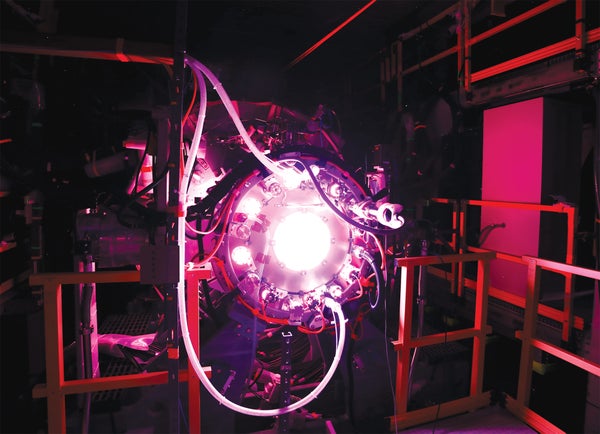
Trenta, Helion's sixth-generation prototype, produced plasma temperatures of 100 million degrees Celsius during testing—a record for a private fusion machine.
Helion
“The unique thing about FRCs: We call them ‘self-organized,’” says experimental physicist John Slough. “It’s like spinning a top.” But “if you try to screw around with it, you’re just going to mess it up.”
Slough spent decades working to keep the idea alive. By the early 2000s federal support for alternative fusion concepts had largely dried up; Slough, then at the University of Washington, continued on a shoestring, with small space-propulsion contracts from NASA and the U.S. Air Force. A key insight was that two FRC plasmoids could be formed with magnetic pulses at either end of the reactor, accelerated toward each other at up to 1.6 million kilometers per hour, and made to collide and merge—using the collision itself as a shortcut to fusion temperatures. The reaction takes place in fractions of a millisecond: through a rapid stream of pulses, the fuel is heated, compressed and expanded repeatedly to generate electricity.
Around 2008 Slough hired Kirtley, then a young aerospace engineer, at MSNW, his small R&D company. As federal support ebbed, Kirtley saw something Slough did not: the seed of a start-up. They and an engineering technician named Chris Pihl worked on the idea. With Slough’s blessing, Kirtley and Pihl took the concept to start-up incubator Y Combinator (then run by Altman), and Helion took off. It was part of a pattern in fusion: when public money dried up, some abandoned concepts turned into start-ups.
Another unusual feature of Helion’s approach is what comes after the reaction. Most fusion power plant designs call for using fusion heat to boil water, spin a turbine and drive a generator. Helion is skipping that thermal cycle. As the merged plasma expands after the fusion pulse, it should push back against the magnetic field and induce electric current directly in coils surrounding the machine. Helion claims that when the plasma generates current directly, it can recover electricity at efficiencies over 95 percent. That number matters enormously.
“Fundamental to our technology is direct electricity recovery,” Kirtley says. “If you can recover the electricity at 95 percent efficiency, fusion has to do only that [last] little bit.” Carter agrees that this aspect is Helion’s clearest technical edge—if it works. “That’s a real advantage for Helion,” he says, which “does lower the bar, if they can do that, on how much gain they need.”
That “if” is the whole story. Helion has built seven prototype machines, each more powerful than the last. The latest, Polaris, is a 19-meter device with capacitor banks capable of storing and delivering a staggering 50 megajoules of energy per pulse. Earlier this year Helion announced that Polaris, housed in a 30,000-square-foot facility in Everett, had reached a record 150 million degrees C and, according to the company, had become the first privately developed fusion machine used to “demonstrate” fusion using deuterium-tritium fuel.
The engineering challenges have been brutal. Helion has had to replace research-grade switches with solid-state hardware that can survive hundreds of millions of pulses. To power the machine, the company also has constructed thousands of specialized high-voltage capacitors; Polaris requires enough of the oil-filled devices to fill 150 shipping containers. Through each rapid repetition, all the electrical systems must work in perfect synchrony, with nanosecond timings. Each pulse appears as “this flash of light, like a camera flash,” says Anthony Pancotti, a Helion co-founder. “It produces fusion, recovers that energy, before you can blink your eye.”
This approach shapes Helion’s manufacturing ambitions. It imagines many modular generators, built in factories and shipped to customers like server racks for energy. The company now employs around 600 people, with a heavy emphasis on technicians rather than scientists.
In 2023 Helion announced what it called the first power purchase agreement in fusion, committing to open its Malaga plant by 2028 and supply Microsoft with 50 megawatts of electricity by the following year, with financial penalties for nondelivery. A few months later it announced a 500-megawatt development deal with steelmaker Nucor. Altman recently stepped off the company’s board as OpenAI and Helion explored a possible partnership.
You can’t buy your way around the laws of physics.
But a power deal is not the same thing as a working power plant. Helion’s history, like that of many fusion projects, includes a string of missed deadlines. The company once projected net electricity from an earlier machine by 2024. As the Microsoft date looms, no published results have confirmed net power generation from Polaris.
The sharpest criticism comes from Slough, whose FRC research helped to give rise to Helion. He has since split with the company, and his objection goes to the heart of the design. The core problem, he says, is the same one FRCs have always faced: confinement. In his view, Helion’s aggressive approach of firing plasmas together at extreme speed and compressing them drives instabilities severe enough to produce a “catastrophic” loss of flux before fusion can do the work Helion needs it to do. At those speeds, he says, “you’ve run up against a fundamental aspect of the FRC.”
Helion’s longer-term ambition draws a second line of criticism. The company ultimately wants Orion to run on deuterium and helium-3, which would produce fewer higher-energy neutrons and maximize its direct capture of electricity. But helium-3, produced by the radioactive decay of tritium, is exceedingly scarce, and fusion reactions are harder to achieve, requiring temperatures of about 200 million degrees C. Slough says that the heat and confinement it would require are physically implausible with Helion’s design. Where he once saw possible pathways, he now “can’t see anything in the physics” that would allow it.
Kirtley counters that Slough relies on “dated” one-dimensional models that ignore the speed of its pulses. “Many instabilities do not have enough time to grow,” he says, arguing that Helion’s machines remain stable enough to complete formation, merging, compression and fusion on the required timescale. Helion plans to breed helium-3 from tritium and says that its models suggest it can convert more than 85 percent of the plasma’s energy into useful electricity.
There is also the question of transparency. Helion publishes very little peer-reviewed data about the core performance of its plasma, making it difficult for outside scientists to evaluate its claims. “They don’t publish, and that’s a stance they take,” Carter says. Without more data, he adds, “it is hard to fully assess where they’re headed.”
Another line of scrutiny comes from Karl Lackner of the Max Planck Institute for Plasma Physics in Germany, whose group published formal comments in the Journal of Fusion Energy in February. Their target is a 2023 paper by Kirtley and Helion scientist Richard Milroy, laying out the physics case for the company’s deuterium–helium-3 approach. Central to its projected energy gains is the idea that ions in the plasma can remain far hotter than electrons after the collision and compression—a condition that would reduce the energy input required to sustain the reaction. Lackner’s group argues that once you account for ordinary collisional power transfer, the requirements become “much more demanding” than Helion’s analysis suggests.
For its part, Helion says Lackner’s analysis does not account for the cadence of its pulses. A favorable ion-electron temperature ratio improves efficiency, but the question “is not whether ions can remain hotter than electrons forever but whether the pulse evolves quickly enough” for that nonequilibrium to support efficient fusion and energy recovery.
None of this means Helion will fail. Fusion has a long history of overpromised deadlines and delayed breakthroughs. But private fusion has changed the field’s pace, forcing questions about supply chains and manufacturing into a domain that for decades focused on lab science.
Carter, whose 2021 U.S. Department of Energy report set a 2040 target for the first fusion pilot plant before private capital accelerated the timeline, thinks a pilot plant in the 2030s is feasible. But he is emphatic that no one company can get there by itself.
The supply-chain dimension alone illustrates why. Helion makes its own capacitors and ultrahigh-pressure ceramics; other fusion companies need similar components. Massachusetts-based Commonwealth Fusion Systems is building infrastructure to produce the high-temperature superconducting magnets it needs. But no start-up can fully internalize these industrial-scale obstacles on its own. In April the DOE's Advanced Research Projects Agency for Energy (ARPA-E) said it will invest $135 million—its largest fusion investment to date—to address the “toughest technical barriers” to commercial-scale fusion. “If there’s a way for the public sector to support these supply-chain gaps,” Carter says, “that’s something we should be looking at.”
Back near Malaga, the construction continues. Orion is rising on the plain above the Columbia. Not far away, Helion is preparing a new assembly facility to piece together thousands of intricate components. A short distance downstream, the dam still turns the falling water into light.
Whether Helion will deliver by 2028 is uncertain, as is fusion’s ability to make a meaningful contribution to the grid in the 2030s. The physics still have to cooperate. But by treating fusion as a manufacturing challenge rather than a mainly scientific one, Helion has already changed what the industry believes is possible—and how soon.