
This article is part of a special report on the total solar eclipse that will be visible from parts of the U.S., Mexico and Canada on April 8, 2024.
Editor's Note: Check out the latest weather forecast along the path of totality to learn whether clouds may block your view of the eclipse.
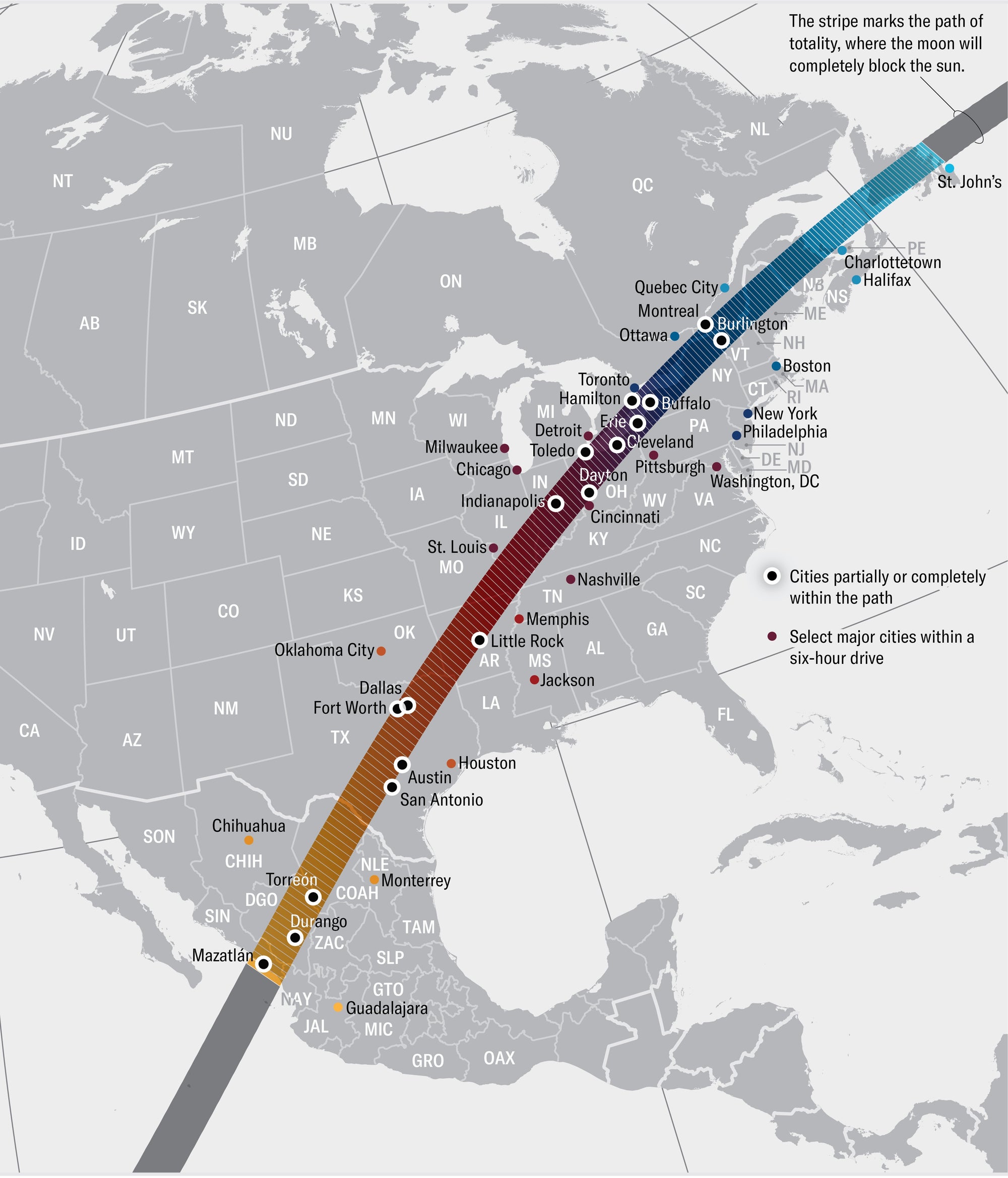
The sun is 400 times bigger than the moon, but it’s also 400 times farther away from us—a glorious cosmic coincidence that has the moon precisely covering the sun’s face when the two align. The result is a total solar eclipse. The alignment is visible only within a narrow band, the path of totality, which will arc across North America on April 8. (The last total eclipse on the continent was in August 2017.) More than 40 million people live within the totality path, and millions more are a few hours away. Spring weather will affect visibility; much of the northeastern U.S. and maritime Canada tends to be cloudy this time of year. If you aim to see the spectacle, keep an eye on the weather and try to stay mobile, recommends Michael Zeiler, an eclipse cartographer who runs the Great American Eclipse website. (The April event will be the 12th he will witness.) Zeiler guarantees that “no one who has ever traveled to see totality has regretted the effort.”
On supporting science journalism
If you're enjoying this article, consider supporting our award-winning journalism by subscribing. By purchasing a subscription you are helping to ensure the future of impactful stories about the discoveries and ideas shaping our world today.
Path of totality
The moon’s shadow hits land in Sinaloa, Mexico, and runs up to Newfoundland, Canada, crossing the continent in just an hour and 35 minutes.* Within the shaded region, totality lasts longest at the centerline, reaching four and a half minutes in some places.
Credit: Katie Peek; Source: NASA (eclipse track data)
Umbra or bust
A partial eclipse is cool—the sunlight thins, and shadows take on a crescent shape—but for seasoned eclipse chasers, the umbra is the only game in town. Within the umbral shadow, the moon covers the sun completely. The sky darkens to a twilight blue, with sunset oranges at the horizon. The faint plasma of the sun’s corona is visible, stretching across the sky.

Credit: Katie Peek; Source: Gridded Population of the World v4, SEDAC (population data); NASA MODIS/Aqua satellite (cloud data); Google Distance Matrix API (drive times)
*Editor’s Note (3/25/24): This sentence was edited after posting to correct the description of the moon’s shadow running up to Newfoundland, Canada.